

Understanding the Capabilities of AI in Processing PDFs and Images
Modern AI systems have made remarkable strides in interpreting complex data formats like PDFs and images, transforming how information is accessed and utilized. These multimodal AI models can extract textual information from scanned documents, recognize embedded imagesand even comprehend the context connecting visual data with written content. Through advanced optical character recognition (OCR) combined with deep learning visual processing, AI no longer just “reads”-it understands. This capability enables the automation of tasks such as document summarization, data extractionand image classification within pdfs, bridging the gap between static content and dynamic analysis.
Key features empowering AI in this domain include:
- Text extraction: Accurate OCR technology converts printed or handwritten text into machine-readable formats.
- Image recognition: Deep neural networks identify and categorize objects, chartsor diagrams embedded in documents.
- Contextual integration: Multimodal systems synthesize textual and visual inputs to enhance comprehension beyond isolated data points.
- Automation efficiency: Streamlining workflows such as legal document review, academic research processing, and compliance auditing.
| Capability | Description | Submission |
|---|---|---|
| OCR | Extracts text from images and scanned documents | Digitizing archives, legal documents |
| Image Classification | Identifies objects and visual elements in PDFs | Analyzing scientific papers, marketing materials |
| Semantic Analysis | Integrates text and image context for deeper understanding | Automated report generation, knowledge extraction |
Technical Challenges and Solutions in Multimodal AI Systems
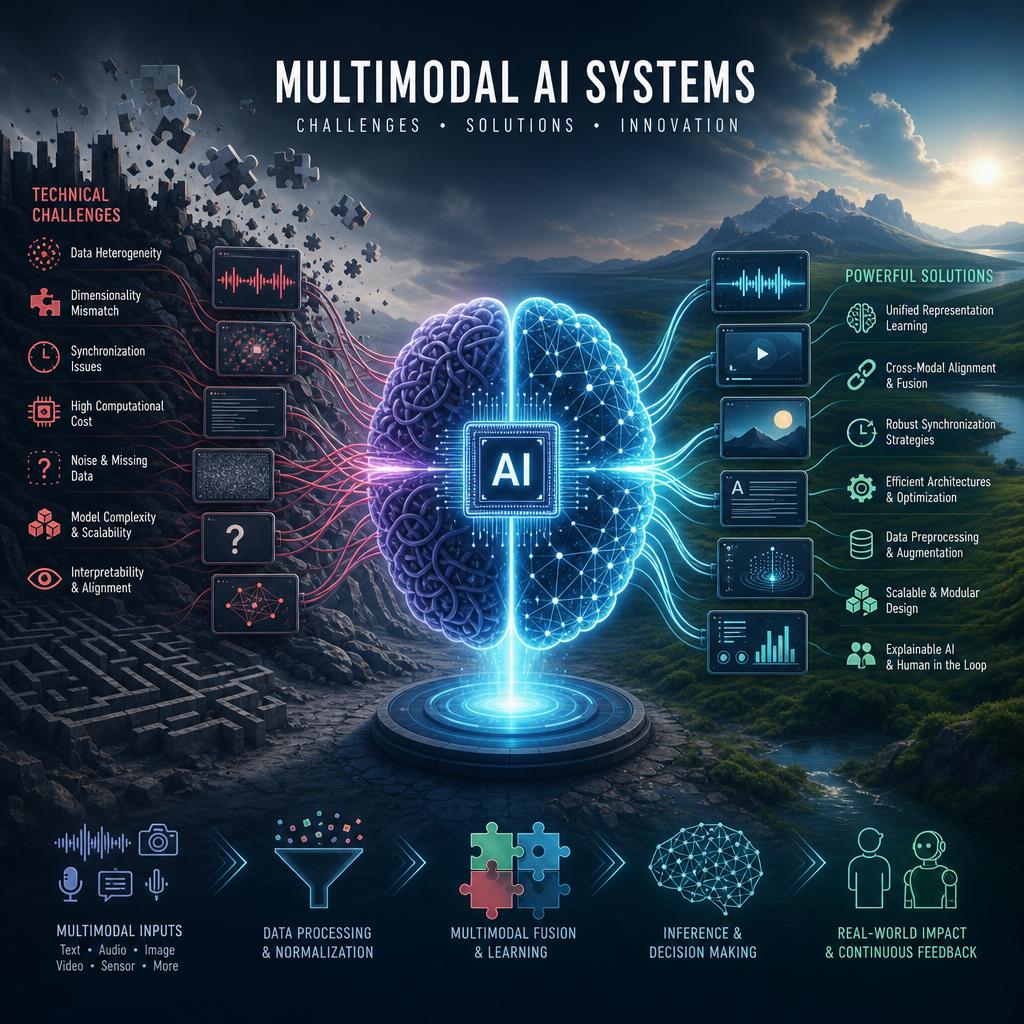
Integrating multiple modalities such as PDFs and images into a unified AI system presents unique technical challenges. One major obstacle lies in the differing data structures: PDFs frequently enough contain complex layouts with embedded texts, tablesand graphics, while images require pixel-level analysis and pattern recognition. To address this,multimodal AI architectures employ specialized encoders each tailored to a specific format. For instance, Optical Character Recognition (OCR) transforms PDFs and text-rich images into machine-readable text, while convolutional neural networks (CNNs) excel at extracting visual features from images. Synchronizing these outputs requires refined attention mechanisms that can correlate textual and visual cues, enabling coherent understanding and accurate interpretation of diverse content.
- cross-modal attention: Aligns relevant features from text and images to enrich context understanding.
- Preprocessing pipelines: Normalize and extract salient data from PDFs and images for uniform input.
- Context-aware fusion: Dynamically integrates multimodal data, adjusting weight based on task requirements.
Another notable challenge is managing inconsistencies such as varied resolutions, noise in scanned documentsor ambiguous visual elements that can confuse interpretation. Robust data augmentation and noise reduction techniques help strengthen model resilience, while adversarial training enhances the system’s ability to handle imperfect or adversarial inputs. Moreover, computational efficiency is critical due to the large-scale nature of multimodal inputs. Optimizations like model pruning, quantizationand hybrid CPU-GPU processing are essential for real-time applications. The following table outlines key challenges alongside their innovative solutions:
| Challenge | Solution | Impact |
|---|---|---|
| Complex Layout Parsing | Hierarchical document embeddings | Accurate structure recognition |
| Image Noise & Variability | Augmentation & denoising algorithms | Improved model robustness |
| Computational Load | Model compression & hardware acceleration | Real-time responsiveness |
Evaluating Accuracy and Limitations in AI-Based Document and Image Analysis
Assessing the precision of AI-driven document and image analysis systems requires a nuanced understanding of both their capabilities and inherent challenges. While these models excel at interpreting structured text in PDFs and recognizing patterns in images, their accuracy can be influenced by several factors, such as document quality, resolutionand the complexity of visual elements. For instance, OCR (Optical Character Recognition) technologies embedded in AI often struggle with handwritten notes or heavily stylized fonts, leading to higher error rates. Similarly, image analysis may falter when faced with low-contrast visuals or ambiguous objects, highlighting the importance of tailored preprocessing and model fine-tuning.
Despite notable advancements, it’s crucial to acknowledge AI’s limitations in multimodal interpretation to set realistic expectations. Common pitfalls include:
- Misclassification due to overlapping or occluded text and images
- Context loss when extracting standalone data elements without semantic linking
- Variability in results depending on the AI’s training dataset and domain specificity
| Factor | Impact on Accuracy | Mitigation Strategy |
|---|---|---|
| Document Scan Quality | Blurred or skewed text reduces recognition rates | Use high-resolution scans and apply image correction filters |
| Font and Layout Diversity | Unusual fonts cause OCR misreads | Incorporate diverse training data and adaptive models |
| Image Complexity | Multiple overlapping objects confuse classifiers | Segmentation and contextual analysis enhancements |
Understanding these nuances aids developers and users alike in optimizing workflows and anticipating when human review remains indispensable, preserving the balance between automation and accuracy.
Best Practices for implementing Multimodal AI in Real-World Applications
When designing multimodal AI systems that interpret PDFs and images,it is indeed crucial to prioritize data alignment across modalities. Ensuring that textual data extracted from PDFs corresponds accurately with visual content in images leads to more coherent and reliable outputs. Employing sophisticated preprocessing techniques, such as OCR optimization for varied font styles and image enhancement algorithms, substantially improves the AI’s comprehension capabilities. Moreover, developers should adopt scalable architectures that accommodate the integration of new modalities seamlessly as technology evolves, establishing a future-proof foundation. Regular assessments and tuning based on real-world feedback will help maintain high accuracy and relevance in diverse application scenarios.
Collaboration and clarity form another cornerstone of success. multimodal models often require interdisciplinary expertise-from linguistics to computer vision-so fostering dialog between domain specialists and AI engineers is essential.Equally vital is documenting model decisions and limitations transparently to build user trust and facilitate troubleshooting. Below is a quick reference table outlining key best practices for implementation:
| Best Practice | Focus Area | Impact |
|---|---|---|
| Data Alignment | Cross-modal coherence | improved contextual accuracy |
| Preprocessing Optimization | OCR & Image clarity | higher input quality |
| Scalable Architecture | Modality integration | Future-proof flexibility |
| Interdisciplinary Teams | Collaboration | Balanced expertise |
| transparent Documentation | User trust & debugging | Clear model understanding |