

The Fundamentals of Post-Deployment Learning in AI Models
Post-deployment learning refers to the ongoing process by which AI models adapt and improve after they have been launched into production environments. While conventional AI systems are often considered static once deployed, modern approaches emphasize continuous learning mechanisms to maintain relevance and accuracy. These mechanisms include fine-tuning with new data,incorporating feedback loops from real-world interactions,and leveraging unsupervised learning methods. The goal is to minimize model degradation over time and ensure responsiveness to evolving patterns without complete retraining from scratch.
Implementing post-deployment learning involves balancing several critical factors, as summarized below:
- Data quality and availability: Models need fresh, reliable data inputs to effectively refine their predictions.
- Computational resources: Continuous updates require efficient use of hardware and energy to remain cost-effective.
- Risk management: Updates must be carefully validated to prevent unintended biases or performance drops.
- Version control: Maintaining clear documentation and rollback capabilities is essential for openness and stability.
| Aspect | Traditional AI | Post-Deployment Learning AI |
|---|---|---|
| Adaptability | Static until retraining | Dynamic and incremental updates |
| Data Handling | Batch updates | Real-time and continuous data streams |
| Risk | Lower risk due to infrequent changes | Higher risk, requires rigorous validation |
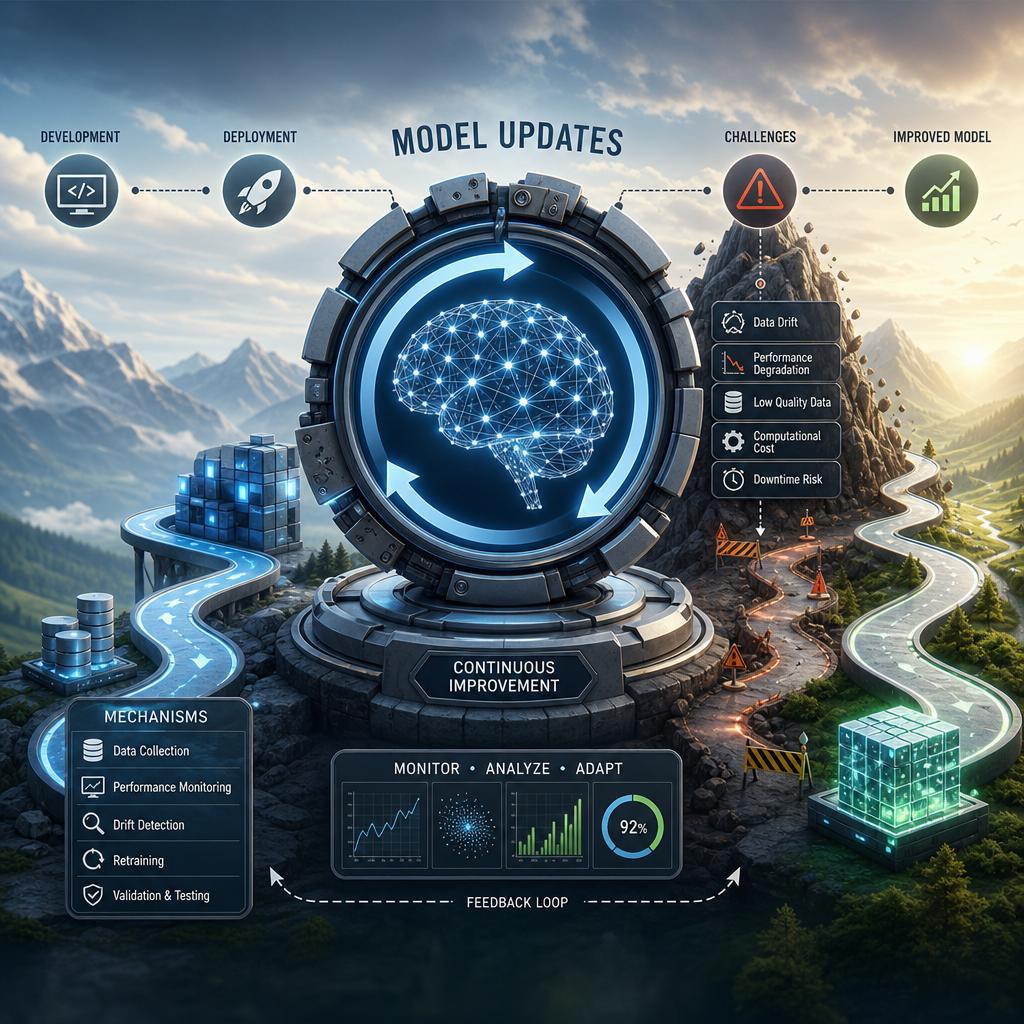
Mechanisms and Challenges of Model Updates After Deployment
Once an AI model is deployed,its surroundings and data landscape can evolve dramatically,necessitating updates to maintain performance and relevance. These updates originate from several mechanisms, such as incremental learning, where new data is incorporated without retraining the model from scratchand transfer learning, which adapts pre-trained models to new domains or tasks. Another common approach is batch retraining, involving periodic re-training on accumulated data to correct drift and improve accuracy. However,integrating updates seamlessly demands a robust validation pipeline to ensure changes do not introduce regressions or biases.
the challenges tied to post-deployment updates are multifaceted. Maintaining model stability while assimilating new inputs can cause performance fluctuations, known colloquially as “catastrophic forgetting.” Moreover, limited access to labeled data in the wild frequently enough restricts supervised fine-tuning, pushing toward semi-supervised or unsupervised strategies. Operational constraints such as compute resources, latency requirementsand compliance also shape update strategies, as outlined below:
| challenge | Impact on Updates | Mitigation Strategy |
|---|---|---|
| Data Drift | Model predictions degrade over time | Continuous monitoring and adaptive retraining |
| Label Scarcity | Challenging to validate update effectiveness | Use self-supervised learning and proxy metrics |
| Resource Constraints | Limited computational budget for retraining | Optimize models for efficient incremental learning |
| Regulatory Compliance | Updates may trigger re-approval processes | Maintain audit trails and explainability |
- Ensuring Robustness: Rigorous testing and rollback mechanisms protect against unintended consequences.
- Continuous Integration: Automating data pipelines and model validation expedites safe updates.
- User Feedback loops: Leveraging real-time user interactions helps guide model improvements.
Evaluating the Impact of Continuous Learning on AI Performance
Continuous learning has transformed AI from static models into dynamic systems capable of evolving with new data streams. This adaptive ability directly influences performance by enabling AI to correct biases, improve accuracy, and maintain relevance in changing environments. Evaluating this impact requires a close look at how updates are integrated post-deployment. Rather than retraining from scratch, incremental learning techniques allow models to assimilate new facts efficiently, reducing downtime and computational costs.
Key factors in assessing ongoing AI performance include:
- Data drift detection: Identifying shifts in data patterns that could degrade model accuracy.
- Update frequency: Balancing between rapid adaptation and stability to prevent overfitting.
- Performance benchmarks: Using consistent metrics such as precision,recall,and F1 scores to quantify advancement or decline.
| Aspect | Impact on AI Performance | Update Strategy |
|---|---|---|
| Data Drift | Potential accuracy drop | Periodic retraining |
| model Stability | Consistency in predictions | Controlled update intervals |
| Computational Efficiency | Resource optimization | Incremental learning |
Best Practices for Implementing Safe and Effective Model Updates
Ensuring that AI models remain both safe and effective after deployment requires a meticulous approach to updating.First and foremost,every update should begin with a thorough validation phase.This involves running updates on sandboxed test environments that replicate real-world scenarios, minimizing the risk of unanticipated failures or biases. It’s also essential to implement incremental updates, applying changes in small, controlled steps rather than large, sweeping modifications. This approach helps in detecting errors early and prevents cascading issues that could jeopardize performance or safety.
Beyond testing, robust monitoring systems are crucial once updates go live. Continuous performance tracking with clear benchmarks allows teams to detect drifts or degradations immediately.Equally importent is maintaining comprehensive documentation for each update, capturing what changed, whyand its observed impact. Consider the following table summarizing key best practices for safe model updates, which can serve as a quick reference for progress teams:
| Best Practice | Key Benefit | Recommended Tools |
|---|---|---|
| Sandbox Testing | Risk reduction before deployment | Simulated environments, Test frameworks |
| Incremental Updates | Quick error detection | Version control, Feature flags |
| Performance Monitoring | early anomaly detection | Dashboards, Alert systems |
| Comprehensive Documentation | Knowledge retention & auditability | Update logs, Change management platforms |