

The Capabilities and Limitations of AI in Website Development
AI has made remarkable strides in automating various aspects of website development,particularly through the generation of code snippets and templates that streamline both front-end and back-end tasks. With advanced natural language processing and machine learning models, AI can interpret user requirements and translate them into dynamic interfaces, responsive layoutsand even server-side logic.This capability accelerates the development process by reducing manual coding effort, enabling developers to focus more on customization and optimization. Though, while AI excels at producing boilerplate code and repetitive components, its understanding of nuanced design aesthetics and complex business logic frequently enough requires human oversight.
despite impressive advancements, certain limitations still constrain AI-generated full-stack solutions. AI tools may struggle with:
- Contextual decision-making: Understanding intricate project requirements that involve multiple layers of abstraction.
- Security considerations: Incorporating best practices proactively to mitigate vulnerabilities.
- Integration challenges: Seamlessly connecting disparate APIs and legacy systems without human intervention.
The table below summarizes these capabilities versus limitations:
| Aspect | Capabilities | Limitations |
|---|---|---|
| Front-End | Generate responsive UI components, CSS styling, accessibility basics | Lacks creativity in design nuances, variable UX preferences |
| Back-End | Produce boilerplate APIs, CRUD operations, database schema suggestions | Cannot fully grasp complex business rules or advanced database optimization |
| Testing & Debugging | Auto-generate unit tests and identify syntax errors | Limited contextual understanding of runtime exceptions or logic bugs |
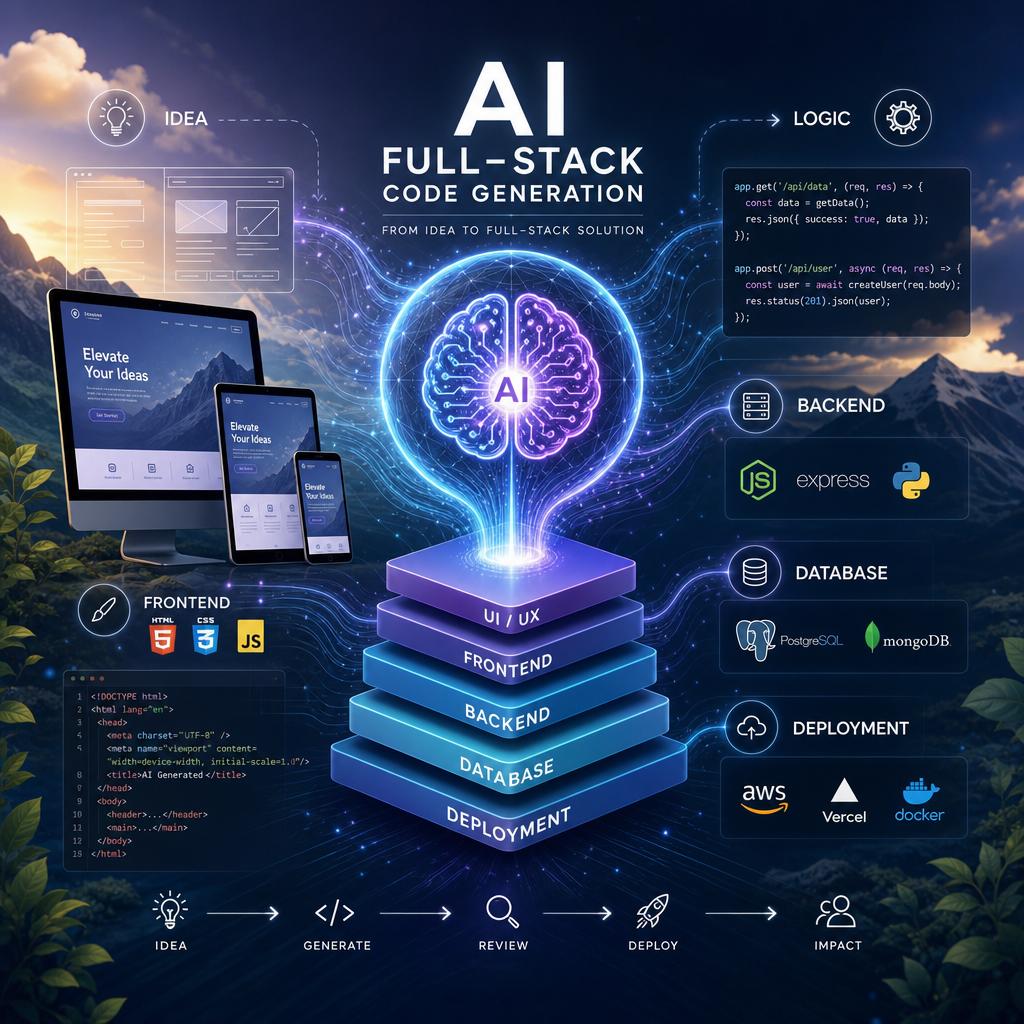
Understanding Full-Stack Code Generation by AI Tools
The rise of AI-powered tools has transformed the landscape of web development, allowing for the automated generation of full-stack code that spans both front-end interfaces and back-end logic. These sophisticated systems leverage advanced machine learning models trained on extensive repositories of source code,enabling them to produce scalable,maintainable applications with minimal human intervention. At the core, AI tools interpret high-level input-such as user requirements or design mockups-and translate them into coherent code structures covering databases, APIs, server-side frameworks, and user experience components.
key advantages of AI-driven full-stack code generation include:
- Speed: Rapid prototyping and deployment reduce traditional development cycles from weeks to mere hours.
- Consistency: Uniform coding conventions and architecture patterns ensure maintainable and bug-resistant outputs.
- Customization: Dynamically tailored solutions respond precisely to unique project specifications.
| Layer | AI Capabilities | Example Outputs |
|---|---|---|
| Front-End | Generates responsive UI components and styling | React components, CSS grids, animations |
| Back-End | Builds RESTful APIs, handles business logic and database schemas | Node.js services, SQL/MongoDB tables |
| DevOps | Automates deployment scripts and continuous integration | Dockerfiles, CI/CD pipelines |
Best Practices for Integrating AI-Generated Code into Web Projects
When incorporating AI-generated code into your web projects, it’s crucial to maintain a rigorous review process. AI tools can expedite development, but they might produce code that lacks context or optimization. Start by thoroughly validating functionality in isolated environments to ensure the generated snippets behave as expected. employ static code analysis tools and linters to catch style inconsistencies and potential security vulnerabilities early on. Additionally, documenting all AI contributions provides clarity for future maintenance and collaborative efforts.
- test incrementally: Break down the integration into manageable pieces and test each separately.
- leverage version control: Use branching strategies to isolate AI-generated changes before merging.
- optimize performance: Refactor generated code to improve load times and scalability.
- Maintain security: Scrutinize generated code for injection flaws, exposing endpointsor sensitive data leaks.
| Aspect | best Practice | Reason |
|---|---|---|
| Code Review | Peer review AI output | Ensures reliability and adherence to standards |
| Testing | Automated and manual tests | detects logic errors and edge case failures |
| Documentation | Explain AI contributions | Simplifies future debugging and updates |
| Security | Security audits | Prevents vulnerabilities from slipping in |
Evaluating AI Solutions for efficient and Scalable Website Building
When assessing AI-driven platforms for constructing websites, it’s critical to focus beyond mere code generation and dive into the implications for efficiency and scalability. AI tools promise accelerated development cycles by automating repetitive tasks such as frontend layout design,backend logic creation,and API integration. However, true efficiency emerges when these systems not only produce syntactically correct code but optimize it for maintainability and performance.Attention must also be given to how well these solutions manage incremental updates and collaboration across development teams, ensuring that AI outputs integrate seamlessly with existing workflows and version control processes.
scalability evaluation frequently enough hinges on the AI’s adaptability to diverse project requirements and complexities. Important factors to consider include:
- Flexibility: Can the AI handle various tech stacks or is it locked into a single framework?
- Customization: How easily can generated code be tailored to bespoke business needs?
- Performance: Does the AI produce optimized code suitable for high-traffic environments?
- Extensibility: Are additional features and modules easily integrated without extensive rewrites?
| Criteria | Key Considerations | Impact on Website Building |
|---|---|---|
| Code Quality | Readability, modularity | Facilitates long-term maintenance |
| Integration | APIs, third-party services | Enables feature-rich experiences |
| Resource Efficiency | Memory, speed optimization | Improves user experience under load |