

The Capabilities and Limitations of AI in App Development
Artificial Intelligence has undeniably transformed the early stages of app development by enabling rapid prototyping from simple textual prompts. By leveraging advanced natural language processing models, developers can now quickly generate user interface mockups, basic workflows, and even snippets of code, significantly accelerating the ideation phase. Though, while these AI tools excel at creating conceptual frameworks and demonstrative models, they frequently enough fall short when it comes to delivering fully functional, production-grade software. The technology excels at identifying patterns and assembling components but lacks the nuanced understanding required to address complex user interactions, security concerns, and seamless performance optimization.
- Strengths: Fast prototyping, idea validation, UI/UX design assistance
- Limitations: Incomplete code, lack of scalability, poor error handling
- Human Role: Critical for integration, testing, customization, and maintenance
| Aspect | AI Capability | Current Limitation |
|---|---|---|
| Code generation | Produces basic functions and structure | fails to handle complex logic and edge cases |
| User Interface Design | Creates initial layouts and styles | Lacks adaptability to diverse user needs |
| Deployment | Not automated | Requires manual configuration and testing |
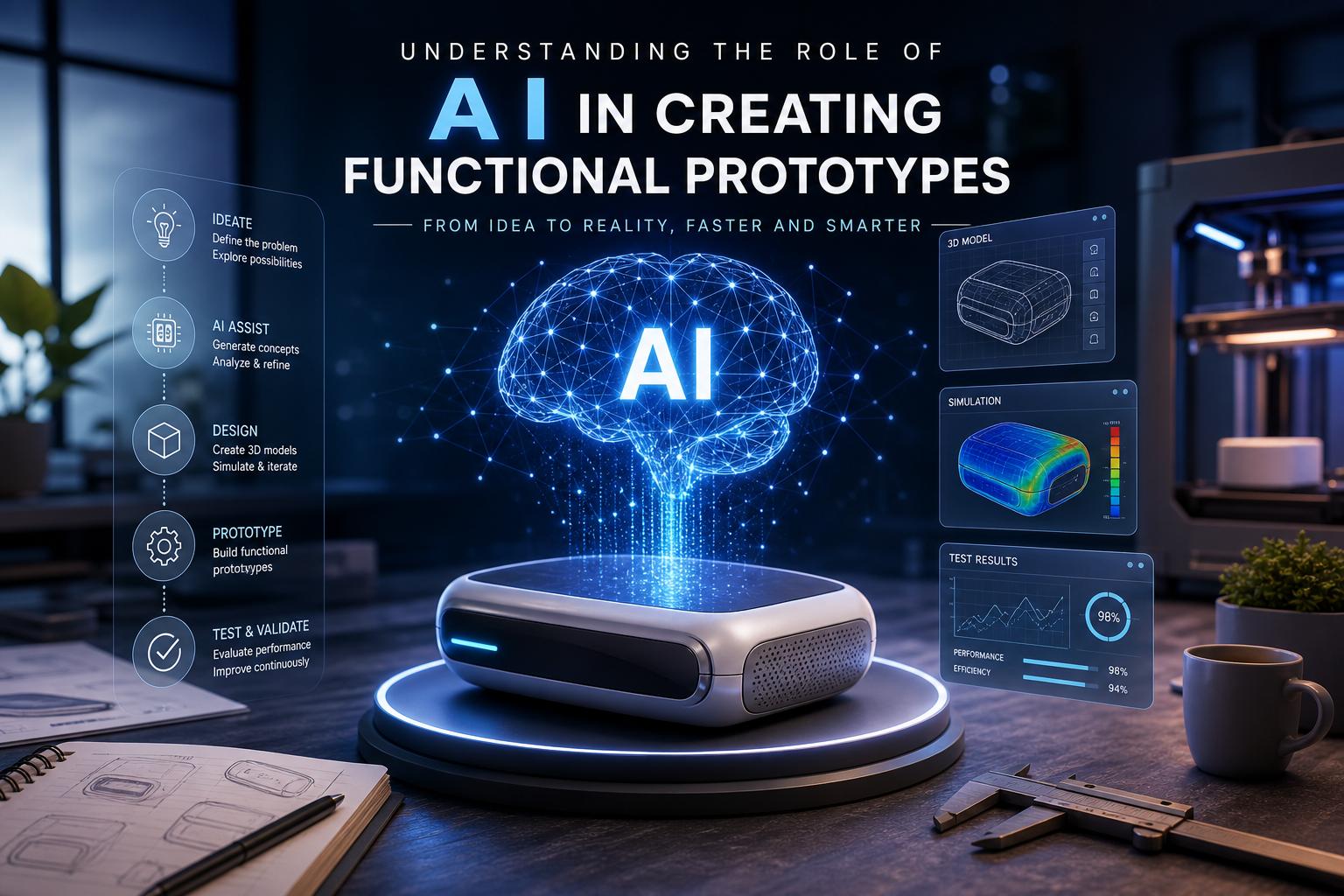
Understanding the Role of AI in Creating Functional Prototypes
Artificial intelligence has emerged as a powerful collaborator in the early stages of app development by rapidly generating functional prototypes that demonstrate core features and user flows. These AI-driven prototypes are particularly valuable for validating concepts, iterating on design, and gathering user feedback without committing substantial resources.By interpreting natural language prompts,AI tools can construct interactive mockups that showcase navigation paths,interface elements,and basic logic,accelerating the translation of abstract ideas into tangible forms.
- Speed: AI prototypes are created in hours or minutes rather of weeks.
- Flexibility: Adjusting features and layouts through prompts is seamless.
- Cost-efficiency: Reduces the need for extensive manual coding early on.
However, the jump from prototype to fully functional, market-ready product remains challenging and complex for AI alone. While prototypes focus on demonstrating concepts, true product development involves deeply integrated backend systems, security protocols, performance optimization, and continuous maintenance-areas where human expertise is indispensable. AI lacks the nuanced understanding needed to architect robust, scalable applications capable of meeting diverse user needs and evolving business goals over time.
| Aspect | Prototype | Full product |
|---|---|---|
| Purpose | Idea validation | Comprehensive solution |
| Complexity | Low to medium | High |
| Development Time | Hours to days | Months to years |
| AI Capability | Strong | Limited |
Barriers Preventing AI from Delivering Fully Finished Products
Despite significant advances, AI-generated applications often fall short of the rigorous demands needed for market-ready products. One major obstacle is the lack of contextual understanding and domain expertise that human developers inherently apply. AI can piece together functional components and generate prototypes efficiently, but it struggles to integrate nuanced customer requirements, anticipate edge cases, or ensure compliance with regulatory standards. Additionally, the absence of intuitive design sensibility limits AI’s ability to create user interfaces that resonate emotionally and behave predictably across diverse user scenarios.
Another substantial barrier lies in the complexity of software testing and debugging, crucial steps that ensure stability, security, and performance. While AI can automate some aspects of code generation, it cannot yet fully replace the meticulous process of validation and iteration that human teams perform. Below is a brief overview of challenges that AI faces in delivering fully finished software products:
- Incomplete Requirements Interpretation: Difficulty grasping ambiguous or evolving user needs.
- Security Vulnerabilities: Inability to proactively identify and fix potential exploits.
- Integration Challenges: Struggles with coordinating dependencies across multiple systems.
- Scalability Issues: Lack of foresight in designing systems for high load or growth.
| AI Capability | Prototype Stage | Final Product Stage |
|---|---|---|
| Code Generation | High Quality | Needs Extensive Refinement |
| Design Adaptability | Basic Wireframes | Highly Customized UX Needed |
| security Handling | Minimal Checks | Critical for Compliance |
| Testing & Debugging | Automated Tests Possible | Human Oversight Essential |
Best Practices for Integrating AI Tools into the Development Workflow
Effectively incorporating AI tools into a development workflow requires a strategic approach that balances automation with human oversight. Developers must prioritize clear task delineation, where AI handles repetitive or data-intensive tasks-such as code scaffolding and syntax suggestions-while human expertise directs architecture, user experience, and quality assurance. Collaboration between AI and developers can dramatically reduce development time, but demands well-defined checkpoints to validate AI outputs against project goals and coding standards. This ensures prototypes generated by AI evolve into robust products rather than incomplete or unstable builds.
Adopting AI in development mandates continuous learning and adaptation. Teams should foster an habitat that encourages experimentation with various AI tools,while together developing skills to troubleshoot AI-generated code and optimize its integration. Consider this comparison of AI tool roles:
| Development Aspect | AI Role | Human Role |
|---|---|---|
| Code Generation | Initial drafts, boilerplate code | Refinement, customization, debugging |
| Testing | Automated test script creation | Interpretation of results, edge case design |
| Design | Idea prototyping | User experience, accessibility considerations |
- Establish integration standards: Define coding style and documentation protocols for AI-generated contributions.
- Monitor AI limitations: Be aware of potential biases and errors in AI outputs and correct them promptly.
- Iterate continuously: Use feedback loops where human review guides AI model refinement over time.