

the evolving capabilities of AI in app development
Artificial Intelligence has transcended its initial boundaries, showing remarkable strides in generating functional applications directly from prompts. Leveraging advanced natural language processing models and code-generation engines, developers can now expect rapid prototyping that transforms abstract ideas into working app sketches within moments. This capability streamlines the early design phases, allowing teams to focus more on innovation rather than repetitive coding tasks.However, while AI excels at quickly producing viable snippets and frameworks, its outputs often necessitate meticulous scrutiny to meet production standards.
Key aspects to consider when integrating AI into app development include:
- Speed vs. Accuracy: AI prototypes accelerate timelines but may introduce subtle bugs.
- Human Oversight: Expert developers must rigorously review and refine AI-generated code.
- Customization limits: AI currently best supports common patterns, needing manual tailoring for niche requirements.
| AI Advantage | Current Limitation |
|---|---|
| Rapid code generation from concise prompts | Occasional logic inconsistencies needing debugging |
| Facilitates early-stage experimentation | Less effective with complex, domain-specific tasks |
| Supports multi-platform prototyping | Integration often requires expert knowledge |
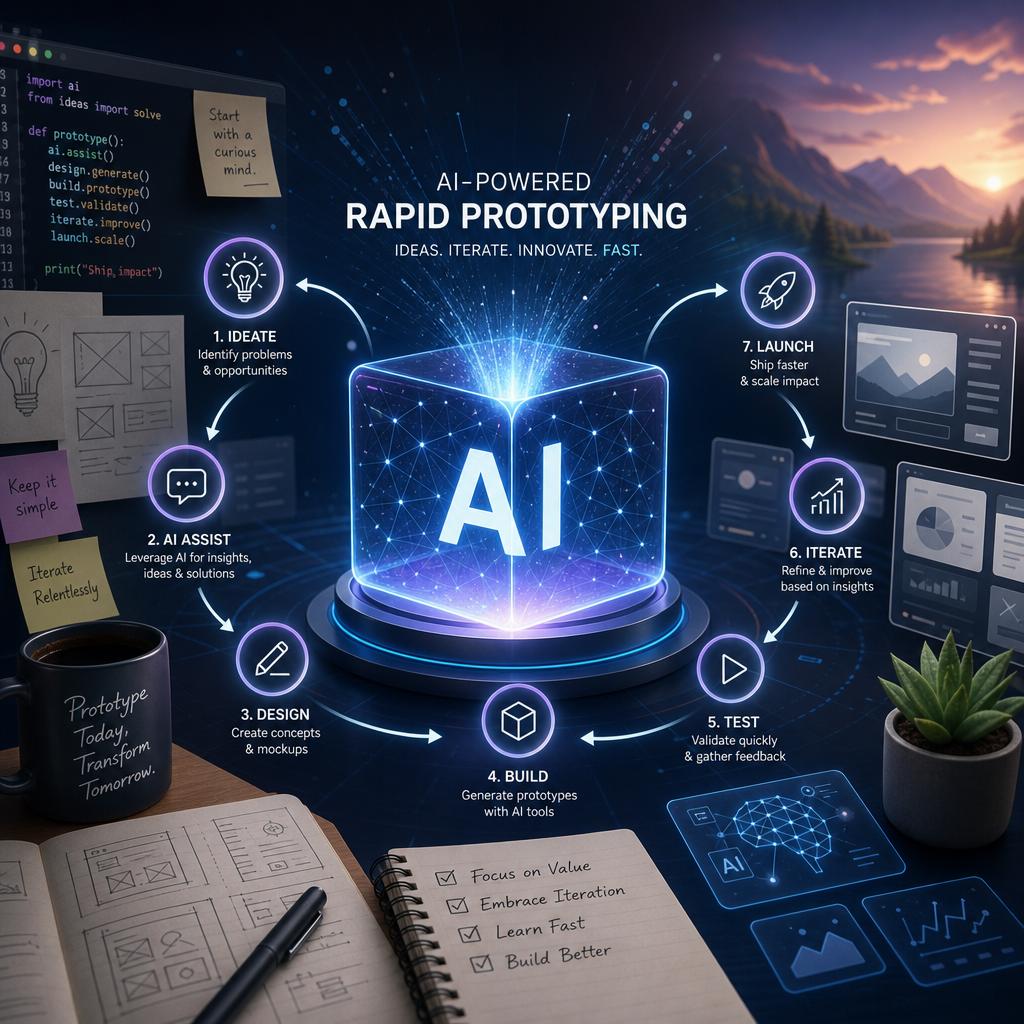
Strategies for leveraging AI to create rapid prototypes
Harnessing artificial intelligence for rapid prototyping transforms the traditional app development lifecycle. By integrating AI-powered design and code generation tools, developers can quickly translate conceptual ideas into functional models. These tools analyze natural language prompts or design sketches to produce initial layouts, user flowsand even backend logic at unprecedented speeds. Key methods include:
- Utilizing AI-driven UI/UX design assistants to produce wireframes and interactive mockups.
- Employing code synthesis models that generate clean, workable code snippets from functional descriptions.
- Implementing automated testing scripts generated by AI to validate core features during prototyping.
This approach not only accelerates the brainstorming phase but also facilitates iterative refinement through immediate feedback loops. However, it’s crucial to combine AI outputs with thorough human expertise to ensure feasibility, security complianceand scalability. Below is a concise comparison of traditional versus AI-augmented rapid prototyping stages:
| Aspect | Traditional Prototyping | AI-Augmented Prototyping |
|---|---|---|
| Speed | Days to weeks | Hours to days |
| Customization | Manual tailoring | Automated suggestions + manual tweaks |
| Iteration | time-consuming | Continuous & rapid |
| Accuracy | Dependent on developer skill | Requires human review for refinement |
Best practices for thorough evaluation of AI-generated applications
To ensure AI-generated applications meet high standards of performance and reliability, a systematic and complete evaluation process is essential. Start by defining clear success criteria aligned with the submission’s intended use case. This involves testing not only for functional correctness but also for usability, security vulnerabilitiesand performance benchmarks. Incorporating a mix of automated testing frameworks alongside human user testing can catch subtle issues that AI prototypes frequently enough overlook. It is particularly crucial to verify the integrity of data handling and interface consistency, as AI-generated code may introduce unexpected behaviors without explicit instructions.
Ongoing assessment should emphasize adaptability and maintainability, given that AI-built apps may require frequent iteration. Teams can benefit from adopting an evaluation checklist highlighting key areas:
- Code quality and readability
- Compliance with security best practices
- Responsiveness and load times
- Compatibility across devices and environments
- User feedback and behaviour analytics
Consider the following example of a quality assurance matrix that supports this thorough review:
| evaluation Area | Metric | Threshold | Status |
|---|---|---|---|
| Security | Vulnerability Scan Coverage | 100% | Pending |
| Performance | Load Time (milliseconds) | <500 | Passed |
| User Experience | Task Completion Rate | >90% | Passed |
By applying these best practices, developers can confidently harness AI’s rapid prototyping power while maintaining rigorous oversight that guarantees a polished, dependable final product.
Ensuring quality and security in AI-assisted app creation
When leveraging AI to generate app prototypes, maintaining quality assurance and robust security measures is paramount. AI can accelerate development by transforming prompts into functional code snippets, but this speed comes with risks. Developers must implement rigorous testing protocols, including static code analysis and dynamic testing, to identify vulnerabilities early.Moreover, relying on AI-generated code requires continuous monitoring for compliance with privacy standards, especially when handling sensitive user data. It’s critical to integrate automated security scans alongside manual code reviews to ensure that no critical flaws slip through the cracks.
- Automated code audits: Identify code anomalies and security loopholes generated by AI.
- Human oversight: Validate AI’s output against best practices and industry standards.
- Version control: Track changes meticulously to spot and revert any suspicious edits.
- Security training: Equip teams to recognize AI-specific risks and mitigation strategies.
| Aspect | AI Benefit | Security Focus |
|---|---|---|
| Speed | Rapid prototype creation | Verify logic and access controls |
| Code diversity | Varied implementation options | Ensure consistent coding standards |
| Scalability | Quick iterations and enhancements | Monitor performance under load and potential exposure |