

The Nature of Errors in AI Agents and Their Impact on Autonomous Systems
errors in AI agents stem from a complex interplay between algorithmic limitations, data quality, and environmental unpredictability. These smart systems, while designed to simulate human-like decision-making, can falter due to incomplete learning, unexpected inputs, or biases embedded within their training sets. The more autonomous the agent, the greater the potential for compounded errors, as self-reliant decision-making bypasses traditional human oversight.This autonomy magnifies not only the frequency but also the severity of errors, making their management a critical concern for developers and users alike.
Understanding the types and sources of errors facilitates the creation of robust control mechanisms, which are essential to maintaining system integrity in real-world applications. Key factors influencing error impact include:
- Feedback Loops: Errors can propagate through system feedback,amplifying consequences.
- Context Sensitivity: Misinterpretations can arise when agents encounter novel or ambiguous environments.
- Adaptation Gaps: Failure to correctly update models in evolving conditions introduces systemic risk.
| Error Type | Impact on Autonomy | Control Strategy |
|---|---|---|
| Data Bias | Distorts decision-making | Regular audits & diverse data |
| Algorithmic Flaws | Misclassification or wrong outputs | Rigorous testing & validation |
| Environmental Variability | Unexpected failure modes | Simulation & real-world monitoring |
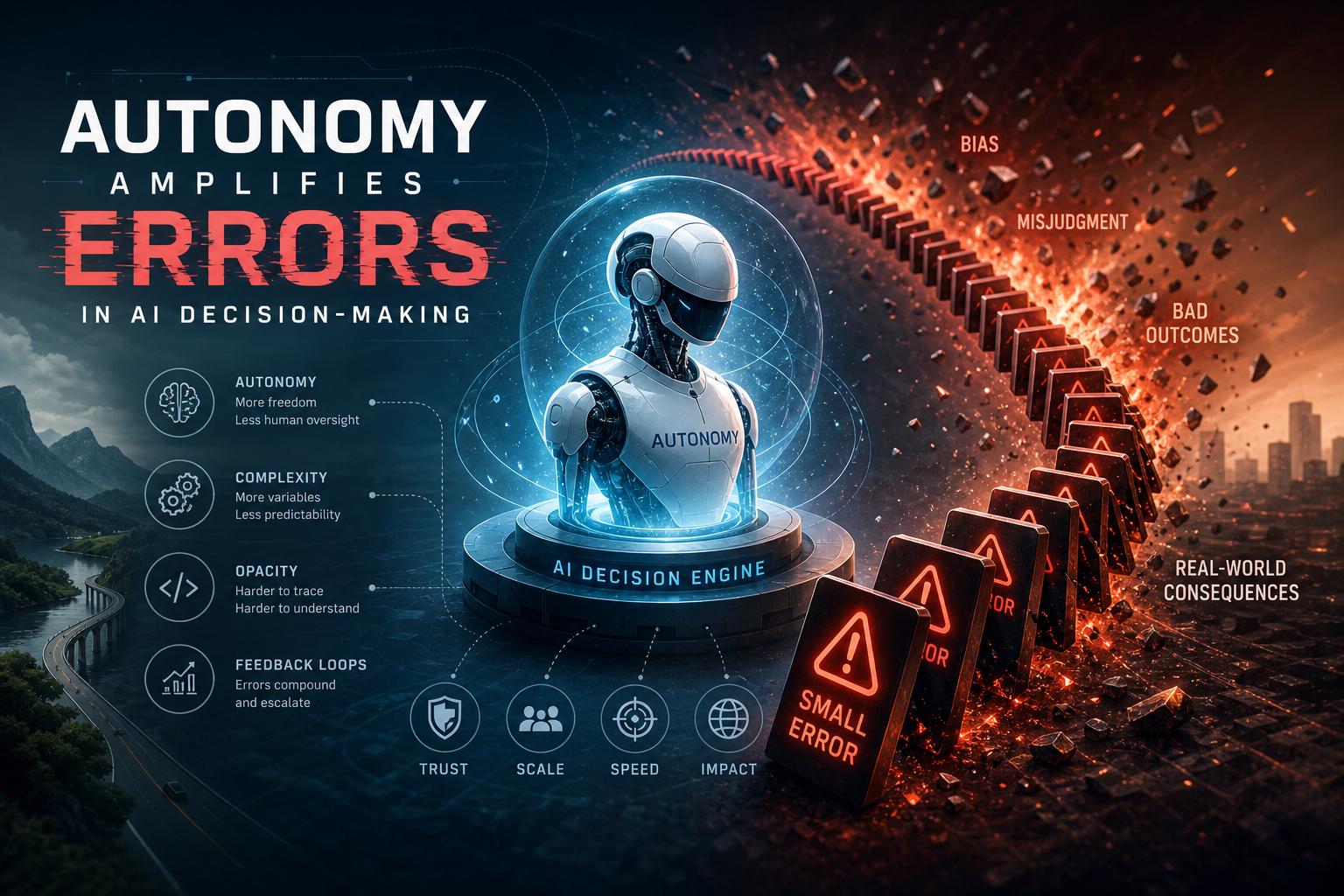
Mechanisms by Which Autonomy Amplifies Errors in AI Decision-making
As AI systems increasingly gain autonomy, their capacity to make decisions without human intervention also intensifies the impact of their mistakes. This phenomenon arises primarily because autonomous AI agents operate by interpreting complex data inputs and executing actions based on algorithmic logic that may not always capture nuanced or contextual subtleties. When errors occur, they are frequently enough compounded through self-reinforcement loops, where one erroneous decision feeds into subsequent steps, magnifying the overall system failure. This can lead to cascading consequences, especially in high-stakes domains like healthcare, finance, or autonomous vehicles, where a single misjudgment could propagate rapidly and cause widespread disruption.
Several factors contribute to this amplification of errors in autonomous AI:
- Decision opacity: Autonomous AI systems can make choices that lack transparent reasoning, making it challenging for humans to detect or correct errors promptly.
- Feedback loops: erroneous outputs can become inputs for future decisions, reinforcing undesirable behaviors or biases over time.
- Scale and speed: Autonomous agents operate at speeds and scales beyond human capability, which means errors are executed quickly and massively before intervention is possible.
| Mechanism | Effect on Error Amplification |
|---|---|
| Opaque Reasoning | Prolonged error detection time |
| Reinforcing Feedback | Escalation of biases and faults |
| Automated Scale | Rapid and widespread error propagation |
Critical Role of Control Frameworks in Mitigating Risks of AI autonomy
As AI systems gain greater autonomy, the potential for errors escalates exponentially. Autonomous AI agents, unlike traditional software, can self-learn and make independent decisions. This capability, while powerful, introduces complex risk vectors that simple reactive measures cannot address. Robust control frameworks provide the essential scaffolding to channel AI behavior within safe and predictable boundaries. By embedding continuous monitoring, risk assessment, and adaptive controls, organizations can reduce the likelihood of unintended consequences stemming from AI decision-making processes.
Effective frameworks focus on multiple layers of control, including:
- Preventive controls that proactively identify and mitigate risks before they manifest.
- Detective controls aimed at real-time anomaly detection to flag deviations promptly.
- Corrective controls that enable swift remediation and learning loops to continuously improve AI behavior.
| Control Type | Purpose | Example |
|---|---|---|
| Preventive | risk avoidance and constraint setting | Pre-deployment bias audits |
| detective | Identifying irregular AI actions | Behavior monitoring dashboards |
| Corrective | Response and adaptation | Automated rollback mechanisms |
The sophistication of autonomous AI demands an equally elegant control architecture. Without such frameworks, the amplification of errors due to AI autonomy can lead to cascading failures, impacting trust and safety. Stakeholders must prioritize embedding governance, openness, and accountable controls as non-negotiable pillars to harness AI’s potential responsibly.
Best Practices for Designing Robust Control systems to Ensure AI Reliability
In the realm of autonomous AI systems, the margin for error can rapidly compound without rigorous controls in place. To guard against this, designing control systems must prioritize fault tolerance and adaptive feedback loops that continuously monitor system states and adjust operations in real-time. Embedding layered controls not only detects anomalies early but also enables corrective actions before cascading failures arise. This multi-tier approach,combined with stringent validation protocols,ensures the AI agent operates within safe,predictable boundaries,effectively reducing unpredictability in its decision-making process.
Equally crucial is maintaining transparency and interpretability within these control systems. When autonomy amplifies risk, clear audit trails and explainable actions empower operators to understand and trust the AI’s behavior. Below is a table highlighting essential design elements and their respective impact on system reliability:
| Design Element | Impact on Reliability |
|---|---|
| redundancy | Prevents single points of failure |
| Real-time Monitoring | Detects anomalies instantly |
| Adaptive Control Algorithms | Enables dynamic response to changes |
| Auditability | Improves transparency and trust |
| Simulation & Testing | Validates robustness under varied scenarios |