

The Nature of AI Agent Autonomy and Its Implications for Error propagation
Autonomy in AI agents grants them the ability to make independent decisions and execute tasks without human oversight.While this independence fosters efficiency and scalability, it also introduces a unique vulnerability: errors made by an AI agent can propagate rapidly and magnify throughout interconnected systems. Unlike conventional software errors, which are typically predictable and contained within static boundaries, autonomous AI mistakes can evolve unpredictably because the agent continuously learns and adapts from its habitat. This dynamic adaptability means that a small misjudgment at one stage may cascade into larger system-wide failures, especially in complex applications like autonomous vehicles, financial trading systems, or healthcare diagnostics.
Key factors driving error amplification in autonomous AI include:
- Decision Feedback Loops: autonomous agents often rely on their own prior outputs as inputs for future decisions, making it possible for errors to self-reinforce.
- Opaque Decision-Making: The black-box nature of many AI models complicates error diagnosis and correction, allowing faults to persist unnoticed.
- Distributed Networks: When multiple AI agents interact, an error in one can rapidly influence others, escalating the overall impact.
| Error Source | Potential Implication | mitigation Strategy |
|---|---|---|
| Data Bias | Distorted decision-making | Regular data audits |
| Model Drift | Performance degradation | Continual retraining |
| Feedback Loop | Error amplification | Human-in-the-loop review |
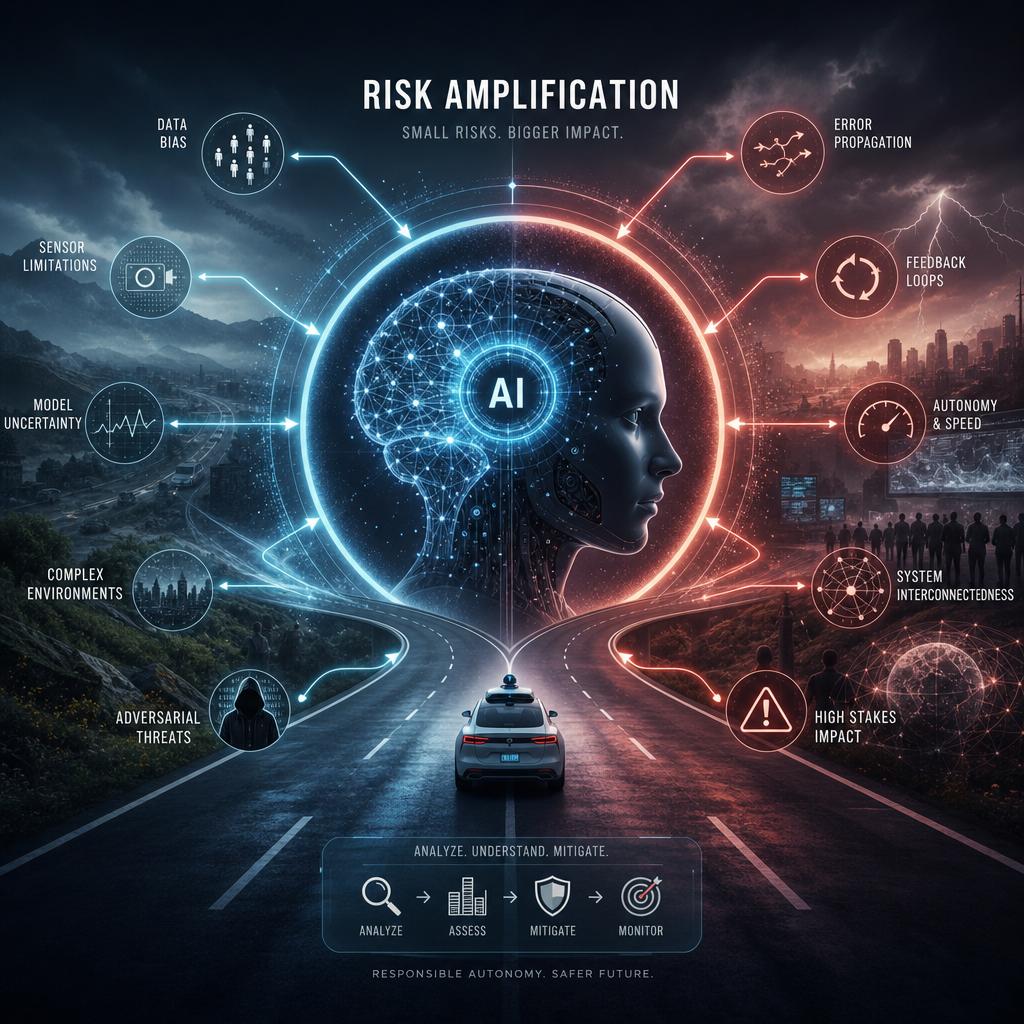
Analyzing risk Amplification Factors in Autonomous AI Decision-Making
Autonomous AI systems, while celebrated for their efficiency and independence, introduce complex layers of risk that are often overlooked.When AI agents operate without continuous human oversight, the potential for error not only persists but can exponentially increase due to intrinsic factors in their decision-making algorithms. These risk amplification factors stem from the AI’s capacity to recursively adapt and optimize its own processes, which can inadvertently lead to unintended consequences. Key contributors include:
- Feedback Loops: Automated decisions influence future inputs, potentially reinforcing flawed patterns.
- Lack of Contextual Awareness: AI may misinterpret or oversimplify nuanced scenarios without human judgment.
- Over-Optimization: Pursuit of efficiency metrics can overshadow ethical or safety considerations.
To better understand these risks,it’s useful to categorize AI decision-making errors by their origin and impact level. This classification highlights how autonomous behavior magnifies risk beyond conventional system faults:
| Error Origin | Risk Amplification Mechanism | Potential Result |
|---|---|---|
| Algorithmic Bias | Self-reinforcing biased data selection | Discriminatory outcomes at scale |
| Model Drift | Autonomous parameter adjustment without validation | Degradation of decision accuracy over time |
| Unforeseen Contexts | Failure to interpret novel scenarios | Systemic misjudgments in critical situations |
Mitigation Strategies to Address Autonomous AI Errors
To effectively mitigate errors stemming from autonomous AI agents, a multi-layered approach is essential. Robust validation frameworks should be employed throughout the AI lifecycle-from initial data acquisition to final decision outputs-to catch anomalies before deployment. Incorporating continuous monitoring systems allows for real-time detection of deviations from expected behavior, enabling prompt intervention.Moreover, embedding human-in-the-loop mechanisms ensures critical decisions are reviewed, reducing unchecked error propagation. transparency through explainable AI models not only aids debugging but also builds trust in automated processes.
Establishing clear protocols for handling errors is equally vital. below is a concise framework outlining key mitigation strategies:
| Mitigation Strategy | Purpose | Implementation Example |
|---|---|---|
| Fail-safe Overrides | Prevent catastrophic errors by halting AI processes | Automatic shutdown on anomalous output detection |
| Adaptive Learning Controls | Prevent reinforcement of erroneous patterns | Periodic retraining with verified datasets |
| Redundancy & Cross-checks | Reduce single-point failure reliance | Parallel AI models comparing outputs |
These strategies represent a proactive stance essential to curbing amplified risks as AI agents gain autonomy, ensuring technology remains a reliable asset rather than an unpredictable liability.
Building Robust Oversight Mechanisms for Independent AI Operations
The evolution of AI agents towards greater independence necessitates a paradigm shift in how oversight is constructed and maintained. Autonomous AI systems, operating with minimal human intervention, present novel challenges that traditional monitoring frameworks were never designed to address. Robust oversight mechanisms must integrate real-time transparency, adaptive control features, and fail-safe contingencies, ensuring that any deviations or unintended behaviors can be promptly detected and mitigated. this calls not only for technological solutions but for an interdisciplinary approach that includes ethical considerations, legal compliance, and continuous human-in-the-loop evaluation where necessary.
key components essential for effective oversight include:
- Dynamic audit trails: Allowing the detailed reconstruction of decision paths for autonomous actions.
- Behavioral anomaly detection: Leveraging AI techniques to flag unexpected or harmful activities automatically.
- Hierarchical control systems: Embedding multiple layers of control that escalate issues from the AI agent to human supervisors.
- Regulatory alignment frameworks: Ensuring AI operates within evolving legal and ethical boundaries.
| Oversight Factor | Function | Benefit |
|---|---|---|
| Transparency | Real-time activity monitoring | Immediate anomaly identification |
| Adaptability | Continuous learning & adjustment | Resilience against novel threats |
| Accountability | Clear logging & audit trails | Traceability for decisions and outcomes |