

AI-Driven Innovations in Battery material Discovery and Optimization
Recent advancements in artificial intelligence have revolutionized the way researchers approach the discovery and optimization of battery materials. By harnessing machine learning algorithms and deep data analytics, scientists can predict the electrochemical properties of novel compounds, dramatically reducing the trial-and-error phase traditionally required in materials science. This acceleration in growth not only cuts costs but also opens avenues for creating batteries with higher energy densities, longer lifespanand improved safety profiles. AI-driven simulations provide a virtual testing ground for materials, swiftly identifying candidates that possess the ideal balance between conductivity, stabilityand scalability for mass production.
Moreover,AI facilitates the optimization of entire battery systems beyond just materials,shaping the future of energy storage solutions through:
- Multi-scale modeling that integrates atomic-level insights with device-level performance metrics.
- Predictive maintenance algorithms that enhance operational efficiency and durability in real-time applications.
- Automated design frameworks that suggest novel electrode architectures and electrolyte compositions tailored for specific use cases.
| Aspect | AI Contribution | Impact |
|---|---|---|
| Material Screening | High-throughput virtual testing | Faster identification of candidates |
| Performance Prediction | Predictive modeling of degradation | Extended battery life |
| System Design | Optimization of component integration | Improved energy efficiency |
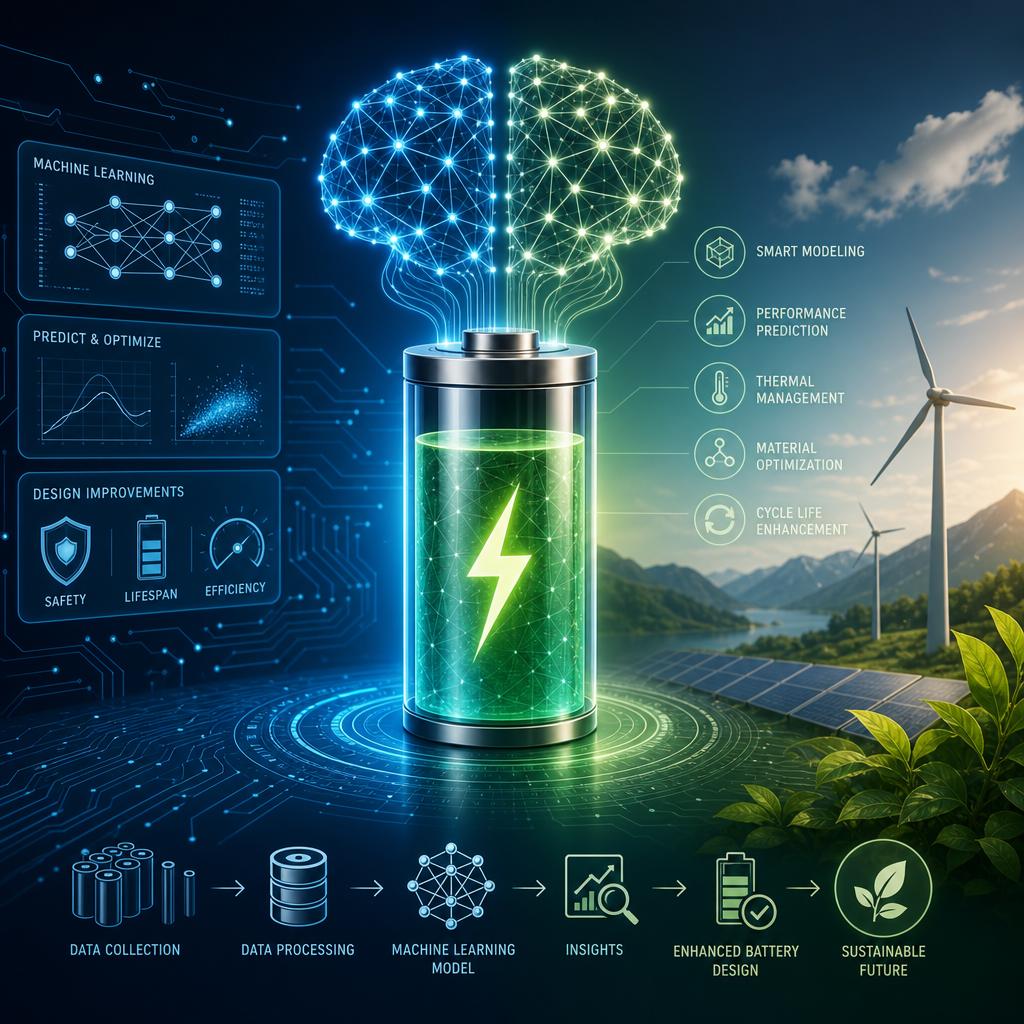
Enhancing Battery System Design Through Machine Learning Integration
advancements in machine learning have revolutionized how engineers approach battery system design, enabling unprecedented optimization and predictive capabilities. By harnessing large datasets from material properties, manufacturing conditionsand operational environments, machine learning algorithms can identify patterns impossible for traditional methods to discern. These insights facilitate the creation of batteries that are not only more energy-dense but also safer and longer-lasting. Key machine learning contributions include:
- Accelerated discovery of novel electrode and electrolyte materials.
- Predictive modeling to anticipate degradation mechanisms under varied usage scenarios.
- Optimization techniques that tailor design parameters for specific performance goals.
Additionally, integrating machine learning directly into battery management systems allows real-time adaptation to changing conditions, improving overall efficiency and lifespan. The following table summarizes how machine learning enhances critical aspects of battery design and operation:
| Aspect | Traditional Approach | Machine Learning Integration |
|---|---|---|
| Material Selection | Trial-and-error testing | Data-driven predictions of optimal materials |
| Degradation Prediction | Empirical life cycle testing | Real-time modeling with adaptive algorithms |
| System Optimization | Fixed design parameters | Continuous learning from operational data |
Data-driven Approaches to Predictive Performance and Durability
Harnessing the power of extensive datasets, AI-driven models deliver unparalleled insights into battery behavior under diverse conditions. These models leverage ancient performance and environmental variables to forecast future durability with striking accuracy. By incorporating machine learning algorithms, researchers can identify subtle patterns and degradation pathways that traditional analysis might miss, enabling a proactive approach to battery maintenance and design optimization. This predictive precision not only enhances product reliability but also accelerates innovation cycles in battery technology.
- Real-time health monitoring: AI algorithms process sensor data continuously to detect early signs of wear and predict remaining useful life.
- Optimization of cycling protocols: Machine learning helps define optimal charge-discharge cycles to extend battery lifespan.
- Material property correlation: AI identifies key material characteristics that influence performance degradation.
| Battery Type | Prediction Accuracy (%) | Primary Data source |
|---|---|---|
| lithium-ion | 92 | Voltage & Temperature |
| Sodium-ion | 88 | Charge Cycles & Resistance |
| Solid-state | 95 | Impedance Spectroscopy |
Beyond prediction, AI facilitates the design of advanced battery systems with enhanced durability by simulating a multitude of material and structural configurations at scale. Rather of relying on time-consuming experimental trials, AI models rapidly evaluate the impact of compositional tweaks and manufacturing variations.this approach empowers engineers to focus on promising prototypes, reducing costs and time-to-market significantly. Coupled with data-driven feedback loops,continuous improvement becomes seamlessly integrated into the design lifecycle,ensuring that next-generation batteries meet rigorous performance standards with confidence.
strategic Recommendations for Leveraging AI in Battery Technology Development
Integrating AI into the development of novel battery materials presents unparalleled opportunities to accelerate discovery and optimize performance. By harnessing advanced machine learning algorithms, researchers can predict material properties and identify promising compounds without the need for exhaustive physical experimentation. This approach not only reduces development cycles but also cuts costs, enabling faster iteration and refinement of electrode and electrolyte components. To capitalize on AI’s capabilitiesorganizations should invest in high-quality, diverse datasets and foster collaborations between data scientists and materials chemists to bridge domain knowledge with computational expertise.
Beyond materials innovation, AI-driven modeling is revolutionizing battery system design by allowing engineers to simulate and enhance performance metrics such as energy density, charging speedand thermal management. Employing AI-powered optimization methods can uncover design trade-offs that were previously imperceptible with traditional tools. Consider incorporating these strategic focuses:
- Predictive maintenance: Leveraging AI to anticipate battery degradation patterns and extend operational lifespans.
- Multiscale modeling: Integrating AI insights across molecular to system levels for a holistic design framework.
- Real-time adaptive control: Implementing AI algorithms in battery management systems to dynamically adjust operating parameters.
| Aspect | AI Advantage | Impact on Battery Tech |
|---|---|---|
| Material Screening | Accelerated property prediction | Faster new battery chemistries |
| System optimization | Enhanced performance modeling | Higher efficiency and durability |
| Operational Analytics | Predictive diagnostics | Prolonged battery lifecycle |
Ultimately, strategic deployment of AI empowers stakeholders to evolve from trial-and-error experimentation to data-driven innovation, fundamentally transforming battery technology development’s pace and potential.