

AI and Automation defined Clarifying Their Core Functionalities and Objectives
Artificial Intelligence (AI) and Automation both revolutionize the way tasks are executed, but they function with distinctive core methodologies. AI represents systems engineered to simulate human intelligence, learningand reasoning, enabling dynamic decision-making that adapts based on input variations. This adaptability allows AI to handle unstructured data, recognize patternsand continuously improve from experience without explicit programming. Automation, on the other hand, focuses on mechanizing repetitive processes through pre-defined rules and sequences, excelling in environments where tasks are predictable and consistent. Its core objective is to enhance efficiency by eliminating manual intervention in routine operations, offering speed and accuracy within fixed parameters.
To provide a clearer perspective, here is a concise comparison of their core functionalities and primary objectives:
| Aspect | Artificial Intelligence | Automation |
|---|---|---|
| Functionality | Learning, adapting, reasoning with complex data | executing repetitive, rule-based tasks |
| Objective | Emulate cognitive functions to solve new problems | Increase speed and accuracy in routine workflows |
| Data Handling | Unstructured and dynamic data processing | Structured and static data processing |
| Adaptability | High; learns and evolves over time | Low; follows predefined instructions |
| Human Interaction | Tends to simulate or enhance decision-making | Designed to replace or support manual effort |
Understanding these distinctions clarifies why AI is often deployed in problem-solving scenarios requiring flexibility, while automation suits processes demanding consistency and scale. Both technologies, when integrated thoughtfully, can dramatically optimize operational efficiency and innovation.
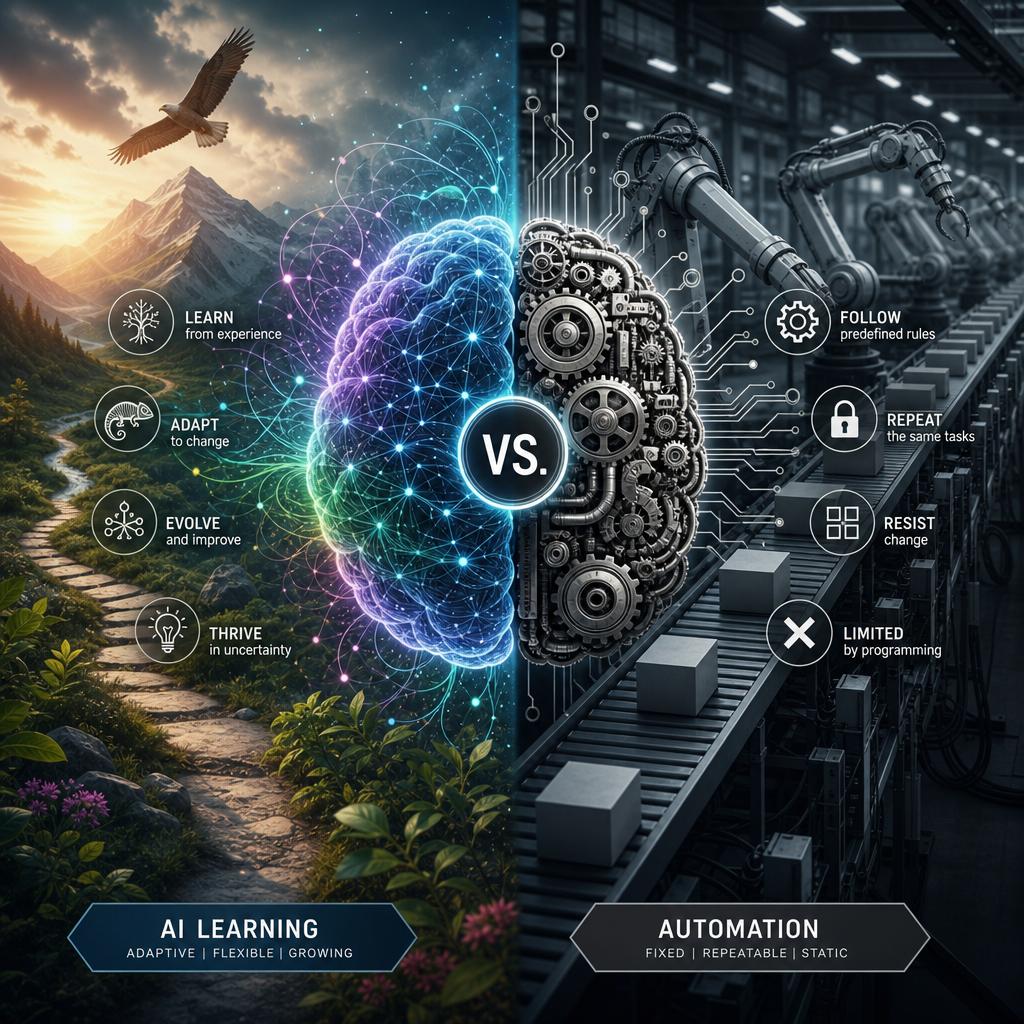
Adaptability in Dynamic Environments Contrasting AI’s Learning Capabilities with Automation’s fixed Processes
Artificial Intelligence (AI) thrives in environments that are in constant flux due to its inherent capacity to learn and adjust in real-time. Unlike automation, which operates on predetermined rules and rigid workflows, AI leverages complex algorithms, such as machine learning, to progressively improve its responses based on new data inputs. This dynamic learning capability enables AI systems to handle unexpected variables and make nuanced decisions that traditional automation simply cannot. AI evolves with every interaction, meaning its performance often increases as it gains exposure to diverse scenarios, making it invaluable in industries where adaptability is key.
- Real-time data processing: AI continuously interprets and learns from ongoing inputs.
- Contextual understanding: It adapts decision-making based on contextual changes and patterns.
- Autonomous advancement: AI refines its operations without human intervention, enhancing accuracy.
Conversely, automation’s strengths lie in repetitive and well-defined tasks where predictability rules. Fixed processes governed by automation excel in consistency and speed but falter when conditions deviate from the original programming. The rigidity inherent in automation means adjustments require manual reprogramming, limiting responsiveness in dynamic settings. The table below succinctly contrasts these traits:
| Capability | AI | Automation |
|---|---|---|
| Learning | continuous self-improvement | Static, rule-based |
| Flexibility | high, adapts to new situations | Low, fixed workflows |
| Error Handling | Adaptive error correction | Requires manual updates |
| Use Case Examples | Customer service chatbots, predictive analytics | Assembly lines, data entry automation |
Functional Scope and Application Assessing the Impact on Industry Efficiency and Innovation
Artificial Intelligence (AI) and automation, while often conflated, differ substantially in their functional scope and the degree to which they influence industry innovation and efficiency. Automation excels in executing predefined, repetitive tasks with speed and precision, offering industries a reliable method to reduce human error and operational costs. Its impact is most apparent in structured environments like manufacturing lines or data-processing workflows, where tasks follow a fixed sequence. Tho,automation’s rigidity limits adaptation beyond its initial programming,which confines its transformative potential to incremental efficiency gains rather than groundbreaking innovations.
Conversely,AI introduces dynamic adaptability through advanced learning algorithms and data-driven decision-making,which enable systems to respond to complex,evolving scenarios. This capacitative breadth empowers industries to innovate by transforming raw data into actionable insights, improving not only process speed but also operational intelligence. The table below contrasts core industry impacts, highlighting where each excels and their practical limitations:
| Aspect | Automation | Artificial Intelligence |
|---|---|---|
| Adaptability | Fixed, rule-based | Learning and evolving |
| Primary Use | Task repetition and speed | Complex problem-solving |
| Innovation Impact | Efficiency improvements | Transformational insights |
| Industry Examples | assembly lines, billing | Healthcare diagnostics, predictive analytics |
- Automation’s strength lies in reliability and consistency for large-scale operational execution.
- AI’s advantage is its capacity to augment human decision-making by adapting to new data and contexts.
- Industries adopting a hybrid approach leverage both tools to maximize efficiency without sacrificing innovation potential.
Strategic Recommendations for Integrating AI and Automation maximizing Benefits While Mitigating Risks
To successfully unite AI and automation within organizational processes, it is essential to adopt a balanced and strategic approach that leverages the strengths of each technology. AI excels at adaptability-learning and evolving based on vast datasets-while automation shines in executing repetitive, rule-based tasks with precision and speed. Companies should first conduct comprehensive workflows analyses to identify where human intervention can be reduced without sacrificing quality or creativity. Prioritizing the integration of AI-driven decision-making tools alongside traditional automation can maximize efficiency gains while also fostering innovation.
Key considerations include:
- Scalability: Design systems that allow gradual expansion of AI capabilities to avoid operational disruptions.
- Compliance and Ethics: Implement monitoring frameworks to ensure AI systems operate within ethical guidelines and legal constraints.
- Continuous Training: Regularly update AI models with new data to enhance adaptability and accuracy over time.
- User Involvement: Engage frontline employees to provide feedback and refine automation processes ensuring practical applicability.
| Aspect | AI Integration | Automation Role |
|---|---|---|
| Flexibility | High, evolves with data | low, rule-based |
| Task Type | Complex decision-making | Repetitive processes |
| Risk Management | Requires oversight | Predictable outcomes |
| maintenance | Frequent updates | Periodic checks |