

The Technology Behind AI Transcription and Its Accuracy in Capturing Meeting Audio
At the core of modern AI transcription is a elegant blend of deep learning models and natural language processing (NLP) algorithms. Thes models are trained on vast datasets comprising diverse accents, dialects, and speech patterns to ensure they can accurately interpret human speech in real time. The technology leverages automatic speech recognition (ASR) systems, which convert spoken language into text by analyzing audio waveforms, identifying phonemesand predicting word sequences.together, these methods enable AI transcription services to handle even complex meeting environments with multiple speakers, overlapping dialogueand background noise.
several critical factors impact the accuracy of meeting transcriptions, including audio quality, speaker clarityand the AI’s contextual understanding. Below is a rapid overview of how these factors interplay to influence transcription outcomes:
| Factor | Impact on Accuracy | AI’s Mitigation Techniques |
|---|---|---|
| Audio Quality | Background noise and poor mic quality distort input | Noise reduction filters and signal enhancement |
| Speaker Variation | Accents and speech pace cause misinterpretation | Adaptive learning models trained on diverse speech samples |
| Contextual Understanding | Technical jargon and homophones confuse raw transcription | Context-aware language models and customized vocabularies |
- Continuous learning: AI systems improve over time with user corrections.
- Multi-speaker differentiation: Identifies and labels individual voices for clarity.
- Integration capabilities: Connects with meeting platforms to automate transcription workflows.
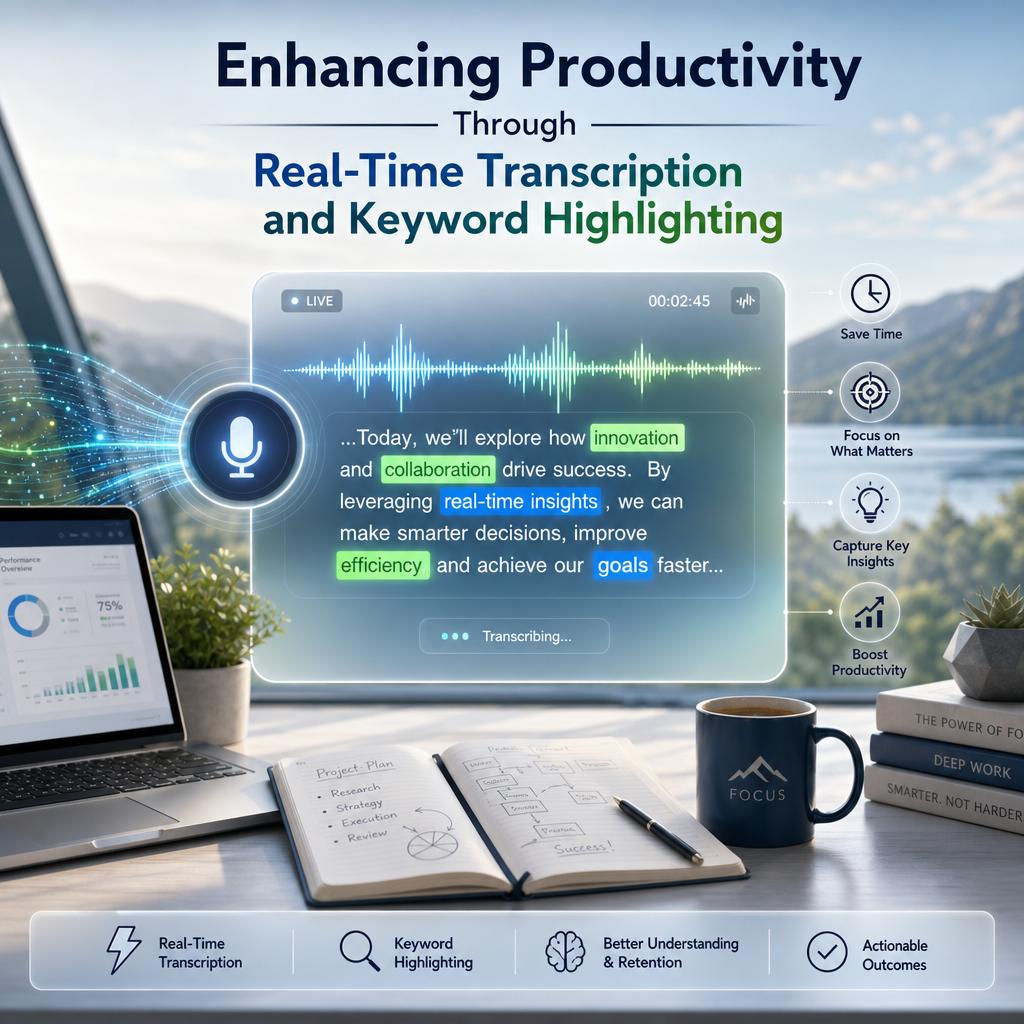
Enhancing Productivity Through Real-Time Transcription and Keyword Highlighting
Leveraging real-time transcription technology transforms conventional meetings into dynamic, actionable sessions. As the conversation unfolds,the transcript is generated instantly,allowing participants to remain engaged without the distraction of manual note-taking. This not only minimizes errors but also ensures that critical points are captured with precision.Moreover, the immediacy of transcription enables swift dissemination of information, accelerating decision-making processes and fostering seamless collaboration across teams.
Enhancing this process with keyword highlighting elevates the efficiency of information retrieval and review. By visually emphasizing essential terms, action itemsand recurring themes, users can quickly scan the transcript for relevant content without wading through extensive text. Consider the following advantages:
- Speed: Instant identification of priority topics facilitates faster follow-up.
- Clarity: Highlights reduce ambiguity, ensuring no vital detail is overlooked.
- Organization: Keywords categorize discussions, simplifying documentation and archiving.
| Feature | Benefit |
|---|---|
| Real-Time Capture | Eliminates lag and inaccuracies in note-taking |
| Contextual Keyword Highlighting | Enhances focus on critical action points |
| Searchable Transcripts | Simplifies retrieval and reference for future tasks |
Best Practices for Integrating AI Transcription Tools into Corporate Workflows
Seamlessly embedding AI transcription tools into your corporate workflow necessitates a strategic approach that enhances interaction without disrupting existing processes. Prioritize selecting tools that offer customizable vocabulary and industry-specific language models to ensure accuracy. Integrate transcription outputs directly into your project management and collaboration platforms to streamline document sharing and review cycles. It’s crucial to establish clear protocols for data security and confidentiality, as sensitive meeting content might potentially be transcribed. Empower team members through training sessions so they can leverage transcription features fully, fostering a culture that values accountability and productivity through easily accessible meeting records.
To optimize the effectiveness of AI transcription, embed quality control mechanisms that combine automated checks with human review, especially for critical decisions and client interactions. Utilize time-stamped transcripts and highlighting tools to make navigation efficient during post-meeting follow-ups. Below is a concise comparative overview of core features that organizations should evaluate when integrating AI transcription solutions:
| Feature | Benefit | Suggestion |
|---|---|---|
| Real-time Transcription | Improves meeting engagement and instant accessibility | Deploy in live client calls and internal stand-ups |
| Multi-language Support | Facilitates global team inclusivity | Choose tools matching your workforce’s linguistic diversity |
| Speaker Identification | Clarifies dialogue attribution for action items | Enable in cross-departmental meetings |
| Integration APIs | Ensures seamless workflow automation | Prioritize platforms with robust API ecosystems |
Ensuring Data Privacy and Security While Utilizing AI Transcription Services
When leveraging AI transcription services, safeguarding the confidentiality of sensitive meeting content is paramount. Providers must adopt robust encryption protocols both during data transmission and storage to prevent unauthorized access. End-to-end encryption ensures that audio files and thier corresponding transcripts remain protected from interception at every stage. Additionally,choosing services compliant with international data protection regulations – such as GDPR or HIPAA – guarantees that privacy standards are rigorously met. It is indeed equally crucial to verify how long the platform retains audio data and transcripts, as opting for services with minimal or user-controlled retention policies significantly mitigates long-term exposure risks.
To further strengthen data security when using AI transcription, organizations should implement strict access controls and audit trails. Fine-grained permission settings enable administrators to restrict who can view, editor share transcripts, while comprehensive logs track all interactions with the data, promoting accountability. Below is a concise overview of essential data security practices for AI transcription usage:
| Security Measure | Purpose |
|---|---|
| End-to-End Encryption | Protects data during transfer and storage |
| Regulatory Compliance | Ensures adherence to privacy laws |
| access Controls | Limits data exposure to authorized personnel |
| Data Retention Policies | Minimizes risk via controlled data lifecycle |
| Audit Trails | Supports monitoring and accountability |