

The Technology Behind AI Transcription and Its Accuracy Challenges
At the core of AI transcription lies a combination of advanced speech recognition algorithms and natural language processing (NLP) techniques.These systems analyse audio waveforms to detect phonetic patterns, then decode them into meaningful text through acoustic and language models trained on massive datasets. The integration of deep learning models, such as recurrent neural networks (RNNs) and transformers, has significantly enhanced the transcription capabilities by enabling context-aware interpretations of spoken language, thereby improving both speed and fluency of output. Moreover,these technologies incorporate adaptive learning to better understand diverse accents and speech nuances,which is crucial in dynamic meeting environments.
Despite these advancements, achieving perfect accuracy remains an ongoing challenge. Factors such as background noise,overlapping speech,and the use of domain-specific jargon or abbreviations complicate transcription quality. Additionally, the AI’s ability to segment and summarize meetings is dependent on accurately identifying speaker turns and discerning key topics. The table below highlights common accuracy hurdles and the corresponding technological solutions being implemented:
| Accuracy Challenge | Technological Solution |
|---|---|
| Background noise interference | Noise-cancellation filters and audio preprocessing |
| Multiple speakers talking together | Speaker diarization and voice separation algorithms |
| Uncommon terminology recognition | Customizable language models with industry-specific lexicons |
| Accurate summarization of key points | Contextual NLP and semantic analysis tools |
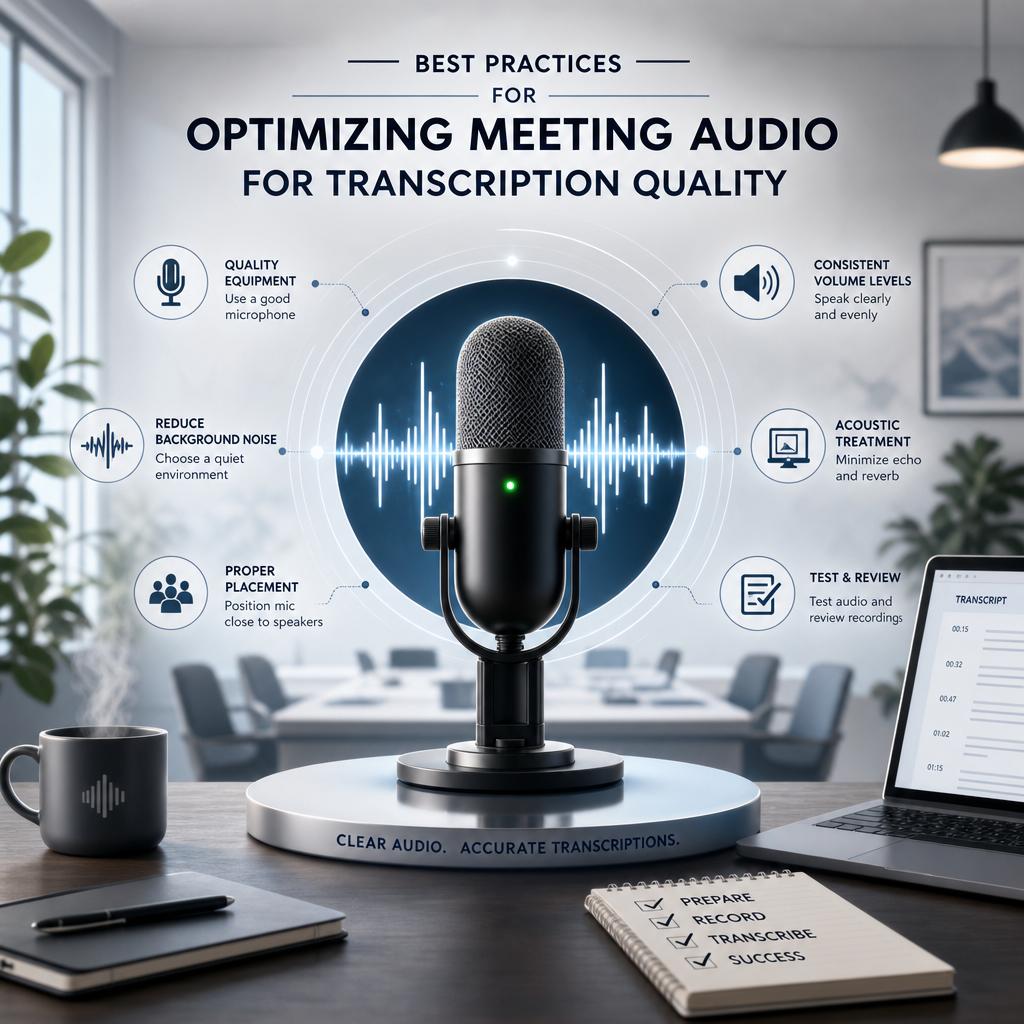
Best Practices for Optimizing Meeting audio for Transcription Quality
Ensuring crystal-clear audio is paramount when utilizing AI transcription tools to generate accurate transcripts and summaries. One of the most effective strategies is to minimize background noise by choosing a quiet environment or using directional microphones that focus solely on the speaker’s voice. Additionally, encouraging participants to speak slowly and clearly helps AI algorithms distinguish words more precisely. It’s also crucial to test audio equipment ahead of time to avoid technical glitches, such as echo or distortion, which can drastically reduce transcription accuracy. Utilizing headphones with built-in microphones can further improve sound clarity by isolating the speaker’s voice.
Consistency in speaker volume and positioning plays a significant role in optimizing transcription results. Make sure each participant maintains a similar distance from their microphones and adjusts their speaking volume to avoid abrupt changes.Consider the following rapid checklist for optimized audio:
- Use high-quality microphones or headsets
- Eliminate or reduce background noise
- Maintain consistent speaker-to-mic distance
- Speak clearly and at a moderate pace
- Monitor audio levels continuously
| factor | Impact on Transcription | Best Practice |
|---|---|---|
| Background noise | High interference, misrecognition | Use noise-cancelling mics or quiet rooms |
| Speaker Clarity | Improved word recognition | Encourage slow, clear speech |
| Mic Quality | Sound fidelity and accuracy | Invest in professional-grade audio gear |
| Stable Audio Levels | Consistent transcript formatting | Regular monitoring and volume control |
Leveraging AI Summaries to Enhance Meeting Productivity and Decision Making
Integrating AI-generated summaries into the post-meeting workflow transforms how organizations consume and act on facts. By distilling lengthy discussions into concise, actionable insights, teams can quickly grasp key points without sifting through entire transcripts. This not only saves time but also enhances focus during decision-making, enabling stakeholders to prioritize critical tasks and accelerate project momentum. AI summaries serve as a reliable reference, minimizing misinterpretations and ensuring alignment across departments, especially in fast-paced environments where clarity is paramount.
Moreover, AI-powered summaries facilitate clarity and inclusivity by making meeting content accessible to participants and absent members alike. Features such as highlighted action items, speaker identificationand topic segmentation enable users to navigate discussions effortlessly. The following table outlines core benefits attributed to leveraging AI summaries in meetings:
| Benefit | Impact |
|---|---|
| Time Efficiency | Reduces review time from hours to minutes |
| Improved Accuracy | Captures essential points without human bias |
| Enhanced collaboration | Supports diverse teams with clear,shared summaries |
| Actionable Insights | Directly highlights decisions and next steps |
Evaluating Security and Privacy Considerations in AI Transcription Services
When leveraging AI transcription services,security protocols must be a top priority due to the sensitive nature of meeting content. Leading providers employ end-to-end encryption during both audio transmission and text storage, ensuring that unauthorized access is prevented at every stage. Additionally, compliance with international data protection regulations, such as GDPR and CCPA, offers users legal assurance that their information is handled responsibly. It’s essential to evaluate whether the service supports role-based access controls and offers detailed audit trails to monitor who accesses or modifies transcriptions.
Privacy concerns extend beyond encryption and regulatory compliance. Users should investigate how their data is used and retained after transcription. Many services implement automatic data deletion policies post-processing, minimizing risk exposure. Below is a comparison table highlighting critical privacy features across AI transcription platforms:
| Feature | Encryption | Data Retention | user Access Control | Compliance Certifications |
|---|---|---|---|---|
| Provider A | End-to-end AES-256 | 30 days auto-delete | Multi-level roles | GDPR, HIPAA |
| Provider B | TLS in transit | Manual user deletion | Basic admin control | CCPA |
| Provider C | End-to-end AES-128 | Unlimited with opt-out | Granular permissions | GDPR, SOC 2 |