

AI-Driven Navigation Systems Enhancing Drone Autonomy
Modern drones increasingly rely on advanced AI algorithms to autonomously interpret complex environments and make split-second decisions. Through integration of deep learning-based navigation systems, drones can process vast sensor data-including LiDAR, visual imageryand GPS signals-to map surroundings, identify obstaclesand choose optimal flight paths without human intervention. This autonomy substantially enhances operational efficiency, allowing drones to perform tasks such as package delivery or infrastructure inspection with minimal risk of collision or mission failure.
Key capabilities enabled by AI-driven navigation include:
- Real-time obstacle avoidance: AI models continuously analyze environmental data to predict and circumvent dynamic obstacles.
- Adaptive route planning: Smart path adjustment based on changing weather conditions or no-fly zones.
- Complex sensor fusion: combining inputs from multiple sensors for accurate localization and environmental understanding.
| Feature | Benefit | Example Application |
|---|---|---|
| Obstacle Prediction | Increased safety | Urban delivery drones |
| Autonomous Rerouting | Mission continuity | search and rescue operations |
| Multi-Sensor Integration | Enhanced situational awareness | Agricultural monitoring |
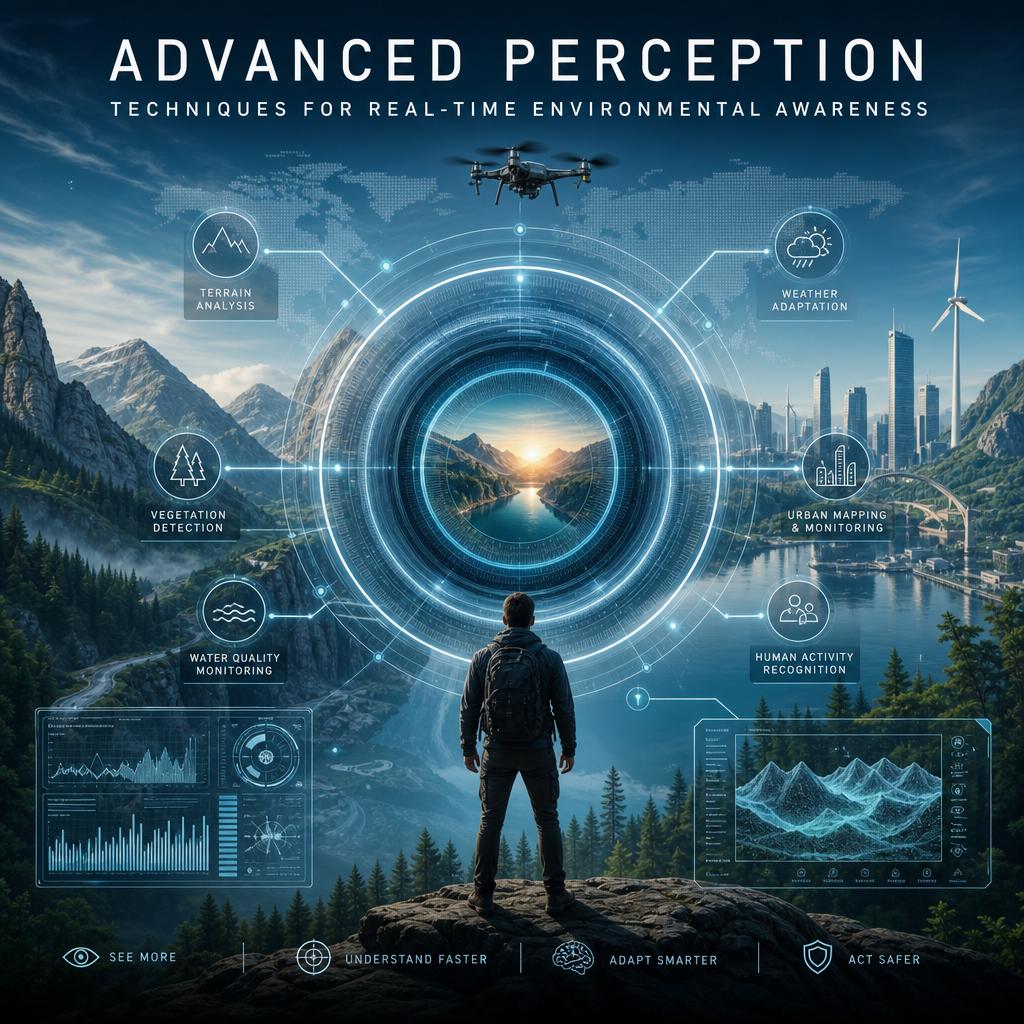
Advanced Perception Techniques for Real-Time Environmental Awareness
Modern drone systems rely heavily on cutting-edge perception algorithms to interpret the environment in real time. these advanced techniques incorporate multi-sensor fusion,combining data from cameras,LiDAR,radar,and infrared systems to create a cohesive,robust depiction of surroundings. This integration allows drones to detect obstacles, map terrain, and identify dynamic objects even under challenging conditions such as low light or adverse weather. Utilizing deep learning models trained on vast datasets, drones can categorize objects with exceptional accuracy, improving decision-making speed and reliability for navigation and mission-critical tasks.
Key components of cutting-edge environmental awareness include:
- Semantic Segmentation: Breaking down scenes into meaningful segments to differentiate between roads, trees, buildingsand people.
- Optical Flow Analysis: Estimating motion within the visual field to predict object trajectories and enhance collision avoidance.
- Depth Estimation: calculating precise distance measurements in real time to support safe maneuvering in complex spaces.
- 3D Mapping & Localization: Generating detailed environmental maps while continuously situating the drone within them for precise control.
| Technique | Application | Benefit |
|---|---|---|
| Sensor Fusion | Combining multi-modal inputs | Enhanced reliability & data richness |
| Neural Networks | Object detection & classification | Improved accuracy in complex scenarios |
| SLAM (Simultaneous Localization and Mapping) | Real-time mapping and positioning | Precise navigation in unkown environments |
Precision Target Tracking Algorithms for Improved Operational accuracy
Advanced computational techniques have revolutionized how aerial vehicles identify and follow moving targets. Leveraging machine learning models and sensor fusion, these systems deliver unparalleled precision in real-time environments. By continuously analyzing dynamic data streams from onboard cameras,lidar,and radar,drones can adapt to sudden changes in target speed and trajectory,significantly reducing tracking errors. Algorithmic innovations such as Kalman filters, particle filters, and deep neural networks enable robust estimation and prediction, even in cluttered or GPS-denied scenarios.
Key features that enhance operational accuracy include:
- Multi-modal sensor integration: Combining visual, thermaland acoustic data to improve target identification under diverse conditions.
- Adaptive learning capabilities: Algorithms refine target models on-the-fly for long-duration missions.
- Latency reduction techniques: Optimized processing pipelines minimize delay between detection and maneuver execution.
- Fail-safe tracking protocols: Redundant systems ensure continued operation despite partial sensor failures.
| Tracking Algorithm | Strength | Typical Use Case |
|---|---|---|
| Kalman Filter | Efficient noise reduction | Linear motion prediction |
| Particle Filter | Handling nonlinear dynamics | Complex target maneuvers |
| Deep Learning Trackers | High adaptability | Visual object recognition |
Robust Control Mechanisms for Safe and Efficient Drone Maneuvering
Innovative control strategies are at the heart of ensuring drones operate with both precision and safety,even in unpredictable environments.Advanced algorithms integrate real-time sensor feedback with dynamic modeling to anticipate and mitigate risks, significantly enhancing maneuverability.These systems employ adaptive control techniques that continuously adjust parameters to maintain stability despite external disturbances such as wind gusts or sudden payload shifts. By leveraging AI-driven predictive analytics, drones can execute complex trajectories while avoiding obstacles and maintaining optimal flight paths with minimal human intervention.
Key elements that strengthen these control mechanisms include:
- Fault-tolerant design: Enables drones to sustain performance when components fail or degrade.
- Multi-sensor fusion: Combines data from LiDAR, camerasand IMUs for robust environment perception.
- Real-time trajectory planning: Recalculates paths dynamically to respond to immediate changes in surroundings.
- Energy-efficient actuation: Optimizes motor commands to balance speed, enduranceand responsiveness.
| Control Feature | Benefit | AI Enhancement |
|---|---|---|
| Adaptive Gain Scheduling | Maintains stability across flight phases | Machine learning models predict optimal gains |
| model Predictive Control | executes smooth and safe maneuvers | Real-time environmental data integration |
| Redundancy Management | Ensures mission continuity despite failures | Automated fault detection and recovery |