

AI-Generated Content Ownership Challenges Across Different legal Jurisdictions
Legal frameworks worldwide grapple with the complexities of defining ownership rights for AI-generated content. Unlike conventional works where human authorship is clear, AI-generated material falls into a gray area that varies considerably depending on jurisdiction. For instance, in the United States, copyright law generally requires human authorship, effectively excluding AI as an author, while certain European countries are exploring adaptive legislation that may recognize AI-assisted creations under specific conditions. This patchwork of regulatory approaches creates important uncertainty for creators, corporations, and investors who rely on intellectual property protections to enforce rights and monetize innovations.
Contracts have emerged as crucial tools to clarify ownership and usage rights where statutory guidance is ambiguous or nonexistent. Key elements often addressed include:
- Assignment of rights: Clearly defining whether the AI developer, user, or a third party owns the resulting content.
- Authorship Attribution: Delineating how authorship is credited, notably when human input is intertwined with machine generation.
- Usage Limitations: Setting boundaries for commercial exploitation, redistribution, or modifications of the AI-generated work.
| Jurisdiction | Authorship Recognition | Contractual emphasis |
|---|---|---|
| USA | Human authorship required | Ownership assignment critical |
| EU (emerging) | Potential AI-assisted recognition | Authorship & usage rights |
| Japan | Mixed approaches | Clear licensing agreements |
Understanding and navigating these jurisdictional variances necessitates crafting robust, adaptable agreements.As laws evolve, staying informed and proactive is essential to mitigate risks associated with ownership disputes in the evolving AI content landscape.
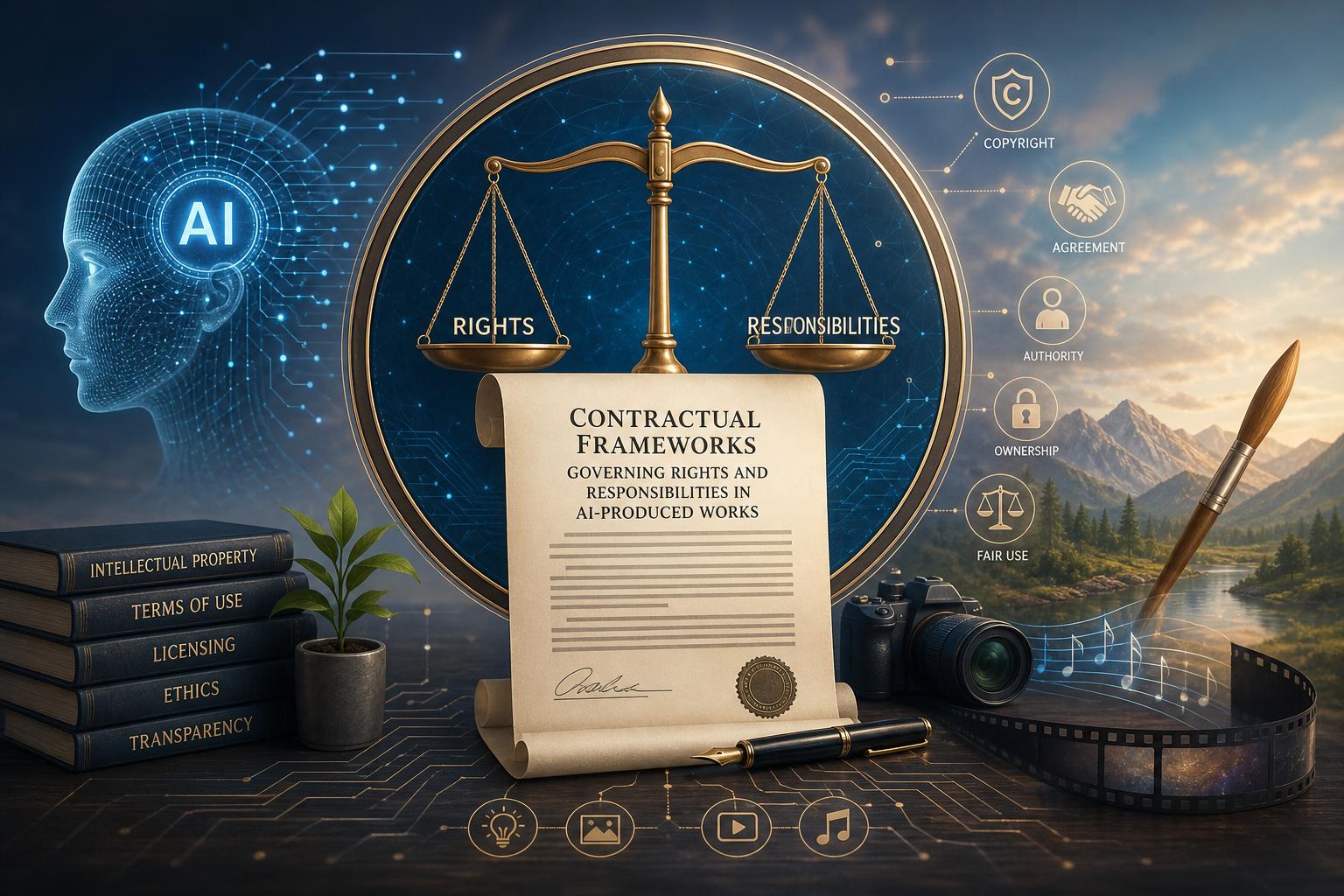
Contractual Frameworks Governing Rights and Responsibilities in AI-Produced Works
The intersection of artificial intelligence with intellectual property has ushered in novel contractual frameworks designed to clarify the ownership and responsibilities associated with AI-produced works. These contracts frequently enough navigate complex terrain by establishing explicit terms related to the creation, use, and commercialization of content generated by AI systems.Key components typically include attribution requirements, licensing protocols, and liability clauses, which collectively aim to balance the interests of AI developers, content creators, and end-users. By delineating these rights and duties, the agreements help mitigate disputes while fostering innovation within a clear legal structure.
Within these contractual parameters, several essential provisions regularly appear:
- Authorship attribution: Defining whether the AI, its operator, or the commissioning party is regarded as the author or owner.
- Usage rights: Outlining how the AI-generated content might potentially be exploited commercially or non-commercially.
- Liability and Indemnity: Assigning duty for any infringement claims or damages emerging from the use of AI content.
- Jurisdiction Clauses: Specifying the governing law and dispute resolution mechanisms applicable to contractual disagreements.
| Contractual Element | Purpose | typical Provisions |
|---|---|---|
| Authorship | Assign ownership and creative credit | Human authorship vs. AI operator attribution |
| Licensing | Define scope of content use | Exclusive, non-exclusive, territorial restrictions |
| Liability | Protect parties from infringement risks | Indemnity clauses, risk allocation |
| jurisdiction | Determine applicable legal framework | Governing law, arbitration settings |
Defining Authorship in the Era of Artificial Intelligence and Its Legal Implications
As artificial intelligence systems become increasingly capable of generating creative content, traditional concepts of authorship face unprecedented challenges. Identifying the legal ‘author’ of AI-generated works is no longer straightforward, especially when the creative process involves collaborative input from humans and machines. Key considerations include:
- Determining whether AI can be considered an author or if authorship rests solely with the human operator or programmer.
- Clarifying the extent to which ownership rights transfer based on the degree of human involvement in guiding or modifying the AI’s output.
- Accounting for varying legal standards across jurisdictions, where some courts may recognize AI-generated works differently.
Contractual agreements have emerged as vital tools for preemptively settling authorship and ownership disputes in this evolving domain. Creators, developers, and users of AI-generated content are advised to clearly define rights and responsibilities through contracts, addressing issues such as licensing, attribution, and liability. The following table outlines practical legal approaches commonly observed in different regions:
| Jurisdiction | Authorship Recognition | Contractual Emphasis |
|---|---|---|
| United States | Human-authored only; AI not recognized as author | Focus on licensing and explicit ownership clauses |
| European Union | possible recognition of joint human-AI authorship debated | Robust data and IP transfer agreements |
| Asia (selected countries) | Varied, evolving legal approaches | Emphasis on clear terms in user and developer contracts |
Strategic recommendations for Securing and Managing AI-Generated Intellectual Property Rights
To effectively secure AI-generated intellectual property rights, organizations must adopt a complete strategy that addresses the unique challenges posed by artificial intelligence. First, it is indeed essential to clearly define ownership through robust contracts that specify rights between developers, AI users, and stakeholders. These agreements should incorporate clauses on data usage, model training, and subsequent content generation, ensuring the chain of authorship is legally sound. Additionally, staying informed about the evolving legal landscape across jurisdictions allows entities to tailor protections that reflect both local and international norms.
Implementing a proactive intellectual property management framework involves several critical actions:
- Regular IP Audits: Continuously assess AI-generated outputs to identify and document proprietary assets.
- Jurisdictional Risk Mapping: Understand how different legal systems treat AI authorship and rights to navigate enforcement effectively.
- Collaborative Governance: Engage multi-disciplinary teams, including legal counsel, technologists, and compliance officers, to oversee content ownership and usage policies.
| key Aspect | Strategic Approach | Expected Outcome |
|---|---|---|
| Authorship Attribution | Explicit contract terms defining creator roles | Clear ownership and reduced disputes |
| Cross-border Enforcement | Legal benchmarking and compliance protocols | Enhanced IP protection in multiple regions |
| Content Management | Systematic audits and digital rights tracking | Comprehensive control over AI assets |