
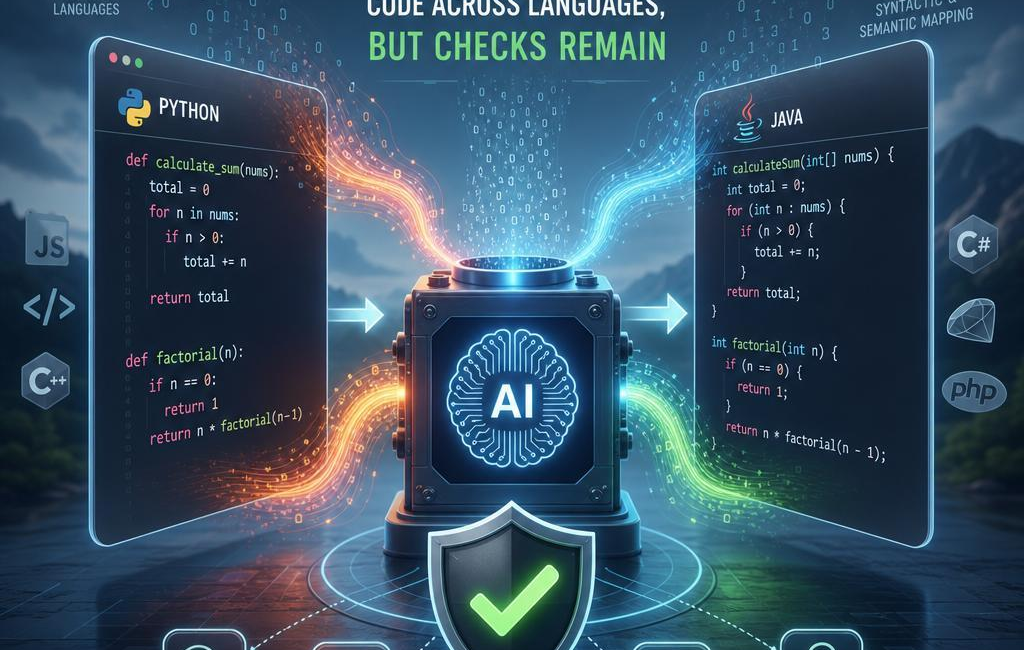
AI Driven Code Conversion enhances Development Efficiency and Cross-Platform Compatibility
Advancements in artificial intelligence have revolutionized the way developers approach code translation between programming languages. By leveraging AI-driven tools, software teams can substantially reduce manual rewriting efforts, ensuring that legacy applications are adapted swiftly for modern environments. These tools utilize sophisticated pattern recognition and contextual understanding to produce high-quality translations that maintain functional integrity across platforms. However, while AI expedites the conversion process, it is crucial to recognize that automated outputs are not infallible. Human oversight remains essential to verify logic correctness, optimize performance, and handle nuances that artificial intelligence may miss.
Key benefits of AI-assisted code conversion include:
- Accelerated Development Cycles: Rapid prototyping and migration enable businesses to meet tight deadlines.
- Cross-Platform Compatibility: Seamless adaptation of applications to diverse operating systems and frameworks.
- Code Consistency: Uniform stylistic and structural transformations that help maintain readability.
| Conversion Aspect | AI Strengths | Human Checks needed |
|---|---|---|
| Syntax Matching | High accuracy in direct translation | Minimal, mostly verification |
| Logic Flow | Good pattern recognition | Critical for complex algorithms |
| Performance Optimization | Basic suggestions | Essential for efficiency tuning |
| API Integration | Limited context awareness | Thorough validation required |
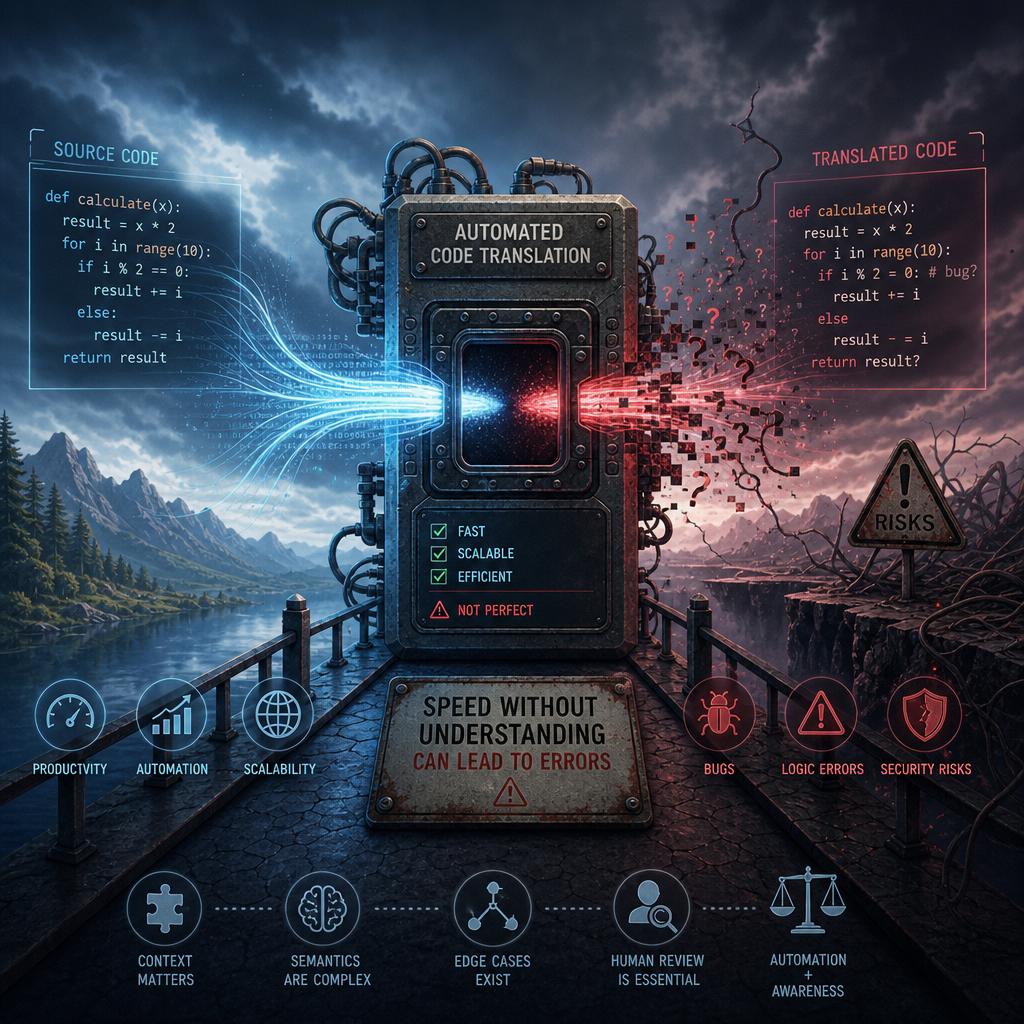
Understanding the Limitations and Risks of Automated Code Translation
While AI-powered tools have made notable strides in translating code from one programming language to another, their outputs are not always foolproof. Automated code translation often struggles with nuanced language constructs, context-specific logic, and idiomatic expressions that seasoned developers instinctively understand. These AI models may overlook subtle performance implications or platform-dependent behavior, possibly introducing bugs or inefficiencies.Developers must recognize that relying solely on AI-generated translations without thorough review can compromise software quality and maintainability.
Key concerns to consider with automated code translation include:
- Semantic inconsistencies: Translated code may syntactically run but behave differently than the original.
- Security vulnerabilities: Automated tools might inadvertently introduce weaknesses by misinterpreting secure coding practices.
- Performance degradation: Naive translations may ignore language-specific optimizations, resulting in slower execution.
- Incomplete feature mapping: Some language features have no direct equivalent, requiring manual adaptations.
| Common Limitation | Potential Impact |
|---|---|
| type system mismatches | Runtime errors or unexpected behavior |
| Unsupported libraries or APIs | Missing functionality or rewrite requirements |
| Formatting and readability loss | Harder code maintenance and review |
| Context loss in logic flow | Incorrect programme outputs |
Ultimately, human expertise remains indispensable. Developers should treat AI translations as a starting point, rigorously validating the generated code through thorough testing and manual inspection. This balanced approach ensures that automated assistance accelerates development without compromising the reliability or safety of software projects.
Best Practices for Verifying and Validating AI-converted Code
When AI tools convert code from one programming language to another, it’s critical to implement stringent verification processes to ensure functionality and reliability remain intact. Code syntax and semantics may appear correct, but subtle logical errors can creep in during translation. Thorough unit testing against known inputs and expected outputs is an indispensable step. Additionally, leveraging static code analysis tools helps detect potential vulnerabilities or inefficiencies that might have been introduced. Pairing automated tests with manual code reviews by experienced developers ensures that the AI-converted output not only meets technical specifications but also adheres to best coding practices.
Maintaining consistent style and readability is another crucial aspect often overlooked. Establishing clear guidelines for code formatting and documentation helps preserve maintainability across the converted codebase. Below is a simple checklist to follow:
- Verify logical correctness through comprehensive test coverage
- Run static analysis and linting to spot inconsistencies
- Conduct peer reviews focusing on style and architectural conformity
- Compare performance metrics before and after conversion
- Document any deviations or assumptions made by the AI tool
| Verification Step | Purpose | tool/Method |
|---|---|---|
| Unit Testing | Test functional equivalence | JUnit, pytest, NUnit |
| Static Analysis | Identify code issues early | SonarQube, ESLint, Pylint |
| Code Review | Ensure readability and standards | Manual peer review |
| Performance Testing | Validate efficiency | benchmark tools |
Recommendations for Integrating AI Code Conversion Tools into Software Development Workflows
To effectively incorporate AI-driven code conversion tools into development workflows, teams must establish rigorous verification protocols. While these tools excel at rapidly translating code between languages,automated checks alone cannot guarantee semantic accuracy or optimal performance. It is critical to pair AI outputs with expert code reviews and comprehensive testing strategies, ensuring that converted code aligns with project standards and functional requirements. Additionally, fostering a collaborative environment where developers can iteratively refine AI-generated code promotes accountability and continuous enhancement.
Organizations should also consider customizing AI models and integrating conversion tools within existing CI/CD pipelines to maximize efficiency and traceability. The following table outlines key recommendations for smooth integration:
| Recommendation | Purpose | Benefit |
|---|---|---|
| Establish QA checkpoints | Validate correctness post-conversion | Prevents propagation of subtle bugs |
| Incorporate developer expertise | Review AI output for best practices | Improves code maintainability |
| Integrate with existing CI/CD | Automate testing and deployment | Speeds up feedback loops |
| Customize AI models | Optimize for specific languages or frameworks | Enhances accuracy and relevancy |
- Balance automation with human judgment to guard against errors that AI might overlook.
- Document conversion outcomes and modifications to maintain openness and ease future audits.
- Regularly update models and tools to adapt to evolving codebases and language standards.