

The Impact of Large AI Models on Cultural diversity in Artistic Expression
Large AI models,while celebrated for their ability to generate art and literature at scale,often impose a subtle but pervasive homogenization of cultural expression. These models are typically trained on vast datasets curated primarily from dominant cultural narratives,leading to a disproportionate emphasis on mainstream styles and themes. As an inevitable result, the unique aesthetics, motifs, and storytelling conventions of less represented cultures risk being diluted or overshadowed. This flattening effect creates an environment where novelty is constrainedand the richness offered by diverse cultural perspectives gets underrepresented in AI-generated works.
Furthermore, the core mechanics of these models prioritize statistical patterns over deep cultural context. This results in generated content that, while technically proficient, may lack the authentic nuance and symbolic meanings embedded in traditional artistic practices. Key challenges include:
- Loss of symbolic Depth: Complex cultural symbols might potentially be abstracted into generic forms.
- Style Uniformity: Distinctive artistic techniques are merged into a single generalized style.
- Content Simplification: diverse narratives are reduced to familiar tropes favored by widely available data.
The table below illustrates these impacts on different art forms:
| Art Form | Effect of AI Model Flattening | potential Cultural Loss |
|---|---|---|
| Visual Art | Repetitive motifs; loss of local color palettes | Regional symbolism, indigenous patterns |
| Music | Standardized beats and scales | Traditional rhythms and instrument timbres |
| Literature | Generic plot archetypes | Oral storytelling traditions and dialects |
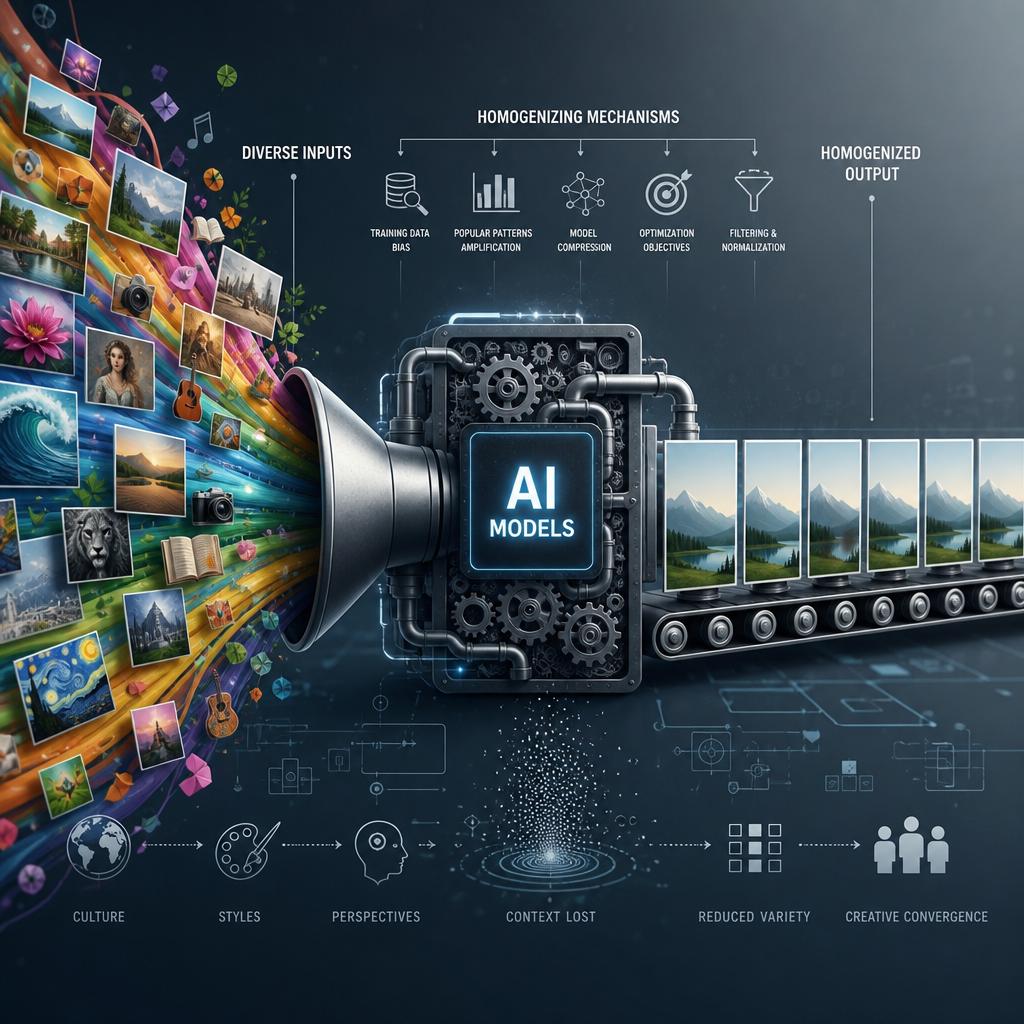
Mechanisms Behind Style and Content Homogenization in AI-Generated Works
At the core of style and content homogenization lies the algorithmic preference for patterns that maximize average predictive accuracy. Large language and multimodal models are trained on vast datasets,aggregating countless cultural expressions into generalized representations. This process inherently filters out unique stylistic flourishes and nuanced thematic elements that don’t frequently appear across the training corpus. As a result,the AI tends to reproduce the most statistically dominant constructs,amplifying familiar motifs and conservative linguistic choices,while marginalizing idiosyncratic or innovative expressions. The reliance on probability distributions smooths out variation, making outputs increasingly uniform across diverse prompts.
Several key mechanisms drive this flattening effect:
- Data Averaging: Combining millions of sources leads to a “middle ground” style that dilutes distinctive local or individual characteristics.
- Loss Function Optimization: Objective functions incentivize minimizing overall error, favoring widely accepted content forms over experimental deviations.
- Token Probability Bias: The model prefers tokens and phrases with higher aggregated likelihood, suppressing rare, context-specific, or avant-garde discourse.
| mechanism | Effect on Output |
|---|---|
| Data Averaging | Homogenizes diverse stylistic inputs |
| Loss Function Optimization | Prioritizes common,less risky content |
| Token Probability Bias | Suppresses unique or rare expressions |
Understanding these mechanisms is critical for anyone seeking to either harness or challenge the normative tendencies of AI-generated culture. Recognizing the inherent trade-offs enables creators to strategically introduce diversity or deliberately counteract the leveling impulses embedded in contemporary generative models.
Consequences of Cultural Flattening for creativity and Cultural Heritage
As AI models increasingly influence creative outputs,the rich tapestry of cultural nuances faces the risk of simplification and homogenization. These large models,trained on massive but generalized datasets,often fail to capture the depth and intricacies that define distinct cultural expressions. This flattening effect undermines originality by favoring broad, market-friendly aesthetics over local or traditional uniqueness. Consequently, creators may unconsciously gravitate towards AI-generated templates that dilute their cultural voice, leading to a gradual erosion of diversity in the arts and media.
Moreover,the preservation of cultural heritage encounters subtle yet profound challenges.When AI mediates content generation, the authenticity of style and context can be lost, affecting how cultural stories and histories are transmitted to future generations. Consider the following impacts:
- Loss of Contextual Richness: Importent cultural symbols and references may be misrepresented or omitted.
- Standardization of Storytelling: Unique narrative techniques become flattened into formulaic patterns.
- Commercial Pressure: AI’s preference for widely accepted motifs sidelines marginalized or niche cultural voices.
| Aspect | Impact on Creativity | Impact on Cultural Heritage |
|---|---|---|
| Stylistic Variation | Reduced experimentation | Homogenized preservation |
| Authentic Expression | Dilution of cultural identity | Misrepresentation risks |
| Narrative Complexity | Simplified storytelling | Loss of oral traditions |
Strategies for Preserving Authenticity and Diversity in AI-Driven Content Creation
To maintain the rich tapestry of cultural and artistic expression in AI-driven content creation,it is essential to implement intentional strategies that counteract the homogenizing tendencies of large language models. One effective approach involves embedding localized and culturally specific datasets into training pipelines. By sourcing and weighting data from diverse global perspectives,developers can ensure the generated content reflects unique vernaculars,idiomatic expressions,and culturally grounded narratives rather than generic universality. Additionally, collaborative curation with cultural experts and community representatives empowers AI systems to respect and preserve nuanced traditions and stylistic particularities, fostering authenticity without sacrificing innovation.
Moreover, establishing evaluative frameworks for diversity and authenticity is critical. These frameworks might include metrics that measure stylistic variance, narrative depth, and cultural accuracy within AI outputs. Such as,a modular scoring system can be designed:
| Evaluation Criterion | Description | Impact on Content |
|---|---|---|
| Stylistic Variation | Assesses diversity in tone and voice | Prevents monotony and flattening of style |
| Cultural Contextuality | Checks for authentic cultural references | Preserves local flavor and meaning |
| Narrative Depth | Measures complexity and uniqueness in storytelling | Encourages rich and engaging content |
By integrating such evaluative controls with ongoing human oversight,AI-assisted creation can evolve into a tool that amplifies rather than erases cultural and stylistic diversity.