

AI and Causality in Science Exploring Foundational Concepts and Challenges
Artificial intelligence (AI) has rapidly transformed scientific inquiry, yet its relationship wiht causality remains complex and multifaceted. While AI excels in pattern recognition and prediction, understanding cause-effect relationships demands more than correlational analysis. This distinction highlights key challenges faced by AI in scientific contexts, such as disentangling confounding variables, modeling counterfactuals, and uncovering hidden mechanisms. Deep learning models, for example, frequently enough operate as black boxes, limiting interpretability and causal inference, whereas causal frameworks prioritize explainability and intervention-based understanding. Progress in this direction requires synergizing AI techniques with causal reasoning principles to enhance robustness and reliability in scientific finding.
Several foundational concepts underlie the dialog between AI and causality, which can be summarized as follows:
- Causal Graphs: Structured representations that map out dependencies and directional influences among variables.
- Counterfactual Reasoning: The ability to consider ”what-if” scenarios beyond observed data, crucial for hypothesis testing and decision-making.
- Interventions: deliberate manipulations in systems that reveal causal effects rather than mere associations.
| Aspect | AI Strength | Causal Science Challenge |
|---|---|---|
| Data Handling | Massive-scale processing | Data quality and bias impacts |
| Model Interpretability | Complex pattern modeling | Transparent causal explanations |
| Prediction | High accuracy on observed data | Generalizing to unseen interventions |
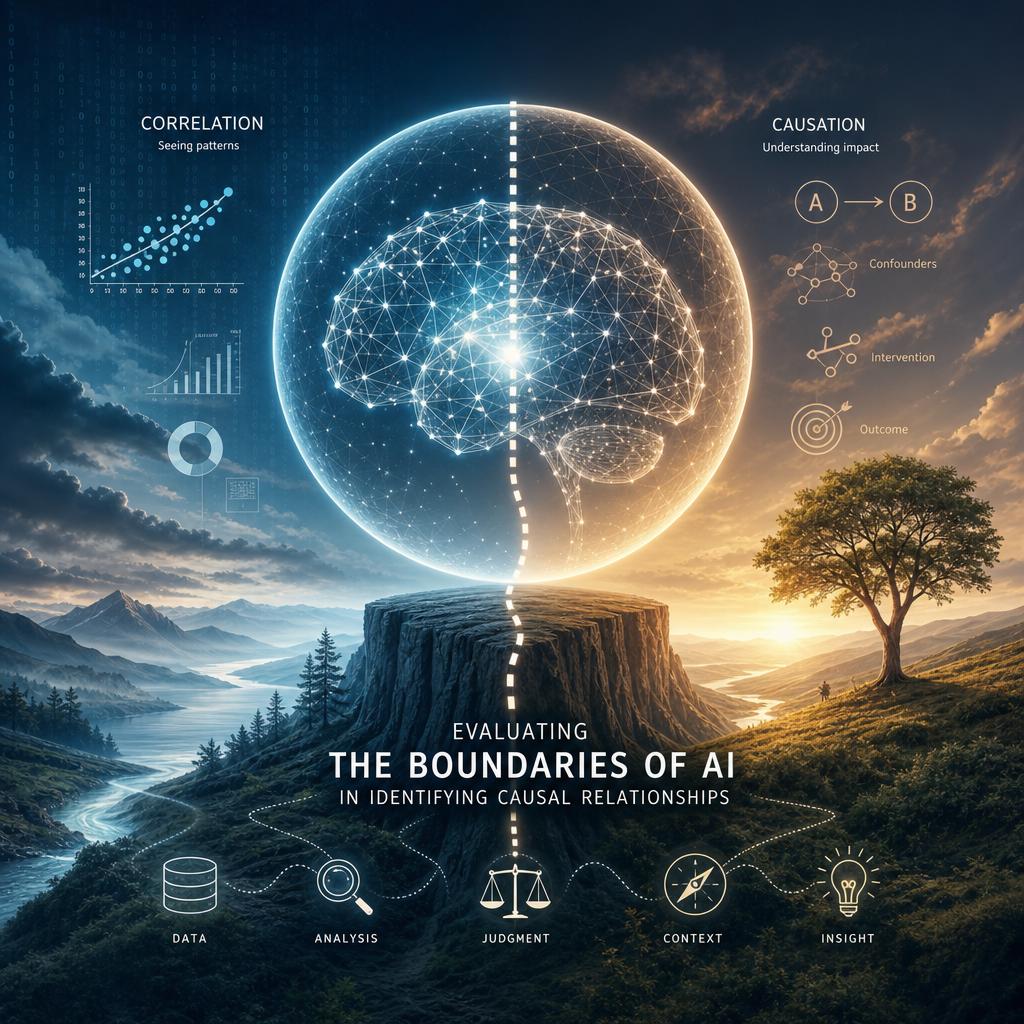
Evaluating the Boundaries of AI in Identifying Causal Relationships
Artificial intelligence (AI) has made notable strides in pattern recognition and predictive analysis, yet its ability to definitively establish causality remains a frontier filled with challenges. Unlike correlation, causality demands a deeper understanding of underlying mechanisms and contextual factors that AI models often struggle to infer purely from data. This limitation is primarily due to AI’s reliance on observational data, which might be confounded by latent variables, temporal ambiguitiesand feedback loops.As a result, AI systems can propose hypotheses about cause-and-effect relationships but cannot conclusively verify them without interventionist or experimental data inputs.
The boundaries of AI in detecting causality are shaped by a few critical factors that researchers must consider:
- Data Quality and Scope: AI effectiveness is bounded by the richness and representativeness of the datasets. Missing contextual data can lead to erroneous causal attributions.
- Algorithmic Clarity: Complex models like deep neural networks often operate as black boxes, limiting interpretability and trust in causal claims.
- Integration with Domain expertise: AI requires complementary insights from scientific disciplines to appropriately frame causal questions and validate findings.
| Challenge | Impact on Causal Identification | Potential Mitigation |
|---|---|---|
| Confounding Variables | False causal links due to unseen factors | Advanced conditioning methods and experimental design |
| Temporal Ambiguity | misinterpretation of cause and effect sequence | Time-series analysis and causality-aware modeling |
| Model Opacity | Difficulty explaining causal pathways | Explainable AI (XAI) and simpler causal models |
Integrating AI with Traditional Scientific Methods for Enhanced Causal Inference
Bridging the gap between cutting-edge AI technologies and established scientific methodologies has become essential for advancing causal inference research. AI algorithms, especially those grounded in machine learning, offer the unparalleled ability to process vast datasets and uncover hidden patterns that traditional methods might overlook. However, these algorithms alone lack the contextual understanding and theoretical rigor required to ascertain true causality from mere correlation. By integrating AI with traditional approaches-such as randomized controlled trials,regression analysis,and domain-specific theory-researchers can combine computational power with scientific discipline.This symbiosis enables a more robust framework for causal discovery, validationand interpretation, ensuring results are not only computationally driven but scientifically meaningful.
Consider the complementary strengths of AI and traditional methods summarized below:
- AI Strengths: Data scalability, pattern recognition, adaptive learning
- Traditional Strengths: Experimental design, hypothesis testing, theoretical grounding
- Unified Result: Enhanced accuracy in causal inference and improved reproducibility
| method | Key Role | Benefit from Integration |
|---|---|---|
| Randomized Trials | Control confounding variables | AI identifies subtle covariate interactions |
| Regression Models | Estimate causal effect sizes | AI optimizes model selection and feature importance |
| Machine Learning | Detect complex nonlinear patterns | Theory-driven constraints prevent overfitting |
By leveraging AI as a powerful analytical assistant within established scientific protocols, researchers can push the boundaries of causal inference beyond current limitations. This integration safeguards against misinterpretations driven by black-box models and fortifies conclusions with empirical rigor, fostering a new standard of evidence in scientific inquiry.
Strategic Recommendations for Leveraging AI to Advance Causal Understanding in Research
Effective integration of AI into causal research demands a rigorously designed framework that combines algorithmic innovation with domain expertise. Prioritizing interdisciplinary collaboration ensures that AI models are grounded in contextually relevant assumptions, enhancing both interpretability and reliability. Researchers should emphasize transparent model architectures that allow validation of causal inferences rather than black-box predictions. This involves developing protocols for systematic sensitivity analyses and counterfactual simulations that explicitly test the robustness of identified causal relationships under varying conditions.
- Embed causal reasoning frameworks within AI pipelines to promote deeper understanding rather than mere correlation detection.
- Invest in rich, high-quality datasets that capture temporal dynamics and confounding variables to reduce bias and improve causal clarity.
- Adopt hybrid methodologies combining symbolic AI with machine learning to leverage strengths in knowlege portrayal and data-driven insights.
| Strategic Focus | Key Actions | Expected Outcomes |
|---|---|---|
| Model Transparency | Develop interpretable causal models and offer clear rationale for decisions | enhanced trust and reproducibility in research findings |
| Interdisciplinary Teams | Facilitate collaboration between AI experts and domain scientists | Contextualized AI applications aligned with scientific goals |
| Data Integrity | Curate datasets to reflect accurate causal contexts including confounders | Reduced bias and improved inference accuracy |