

The Role of Artificial Intelligence in Enhancing scientific Causal Analysis
Artificial Intelligence (AI) is reshaping how scientists approach causal analysis by offering unprecedented computational power and pattern recognition capabilities.Rather than manually probing complex datasets, researchers can now leverage AI algorithms to identify correlations that may hint at underlying causal relationships. However, it is crucial to distinguish between AI as an aid in hypothesis generation and AI as a tool for true causal inference. while AI excels in surfacing potential links within large volumes of data, it doesn’t inherently possess the reasoning abilities to confirm causality without complementary domain knowledge and experimental validation.
Key contributions of AI in scientific causal exploration include:
- Processing vast, multidimensional datasets to spot subtle associations
- Generating plausible causal hypotheses for further investigation
- Automating the identification of confounding variables and latent factors
- Enhancing reproducibility through standardized data-driven approaches
Yet, the difference between aid and genuine inference frequently enough hinges on the interpretation stage, where human expertise and carefully designed experiments remain essential. To illustrate this dynamic, the table below summarizes how AI capabilities intersect with the requirements of causal inference:
| Aspect | AI Strengths | Limitations |
|---|---|---|
| Data Handling | Rapid processing, pattern detection | No intrinsic understanding of causation |
| hypothesis generation | Uncovers hidden associations quickly | Requires external validation |
| Inference | Supports probabilistic modeling | Cannot replace experimental proof |
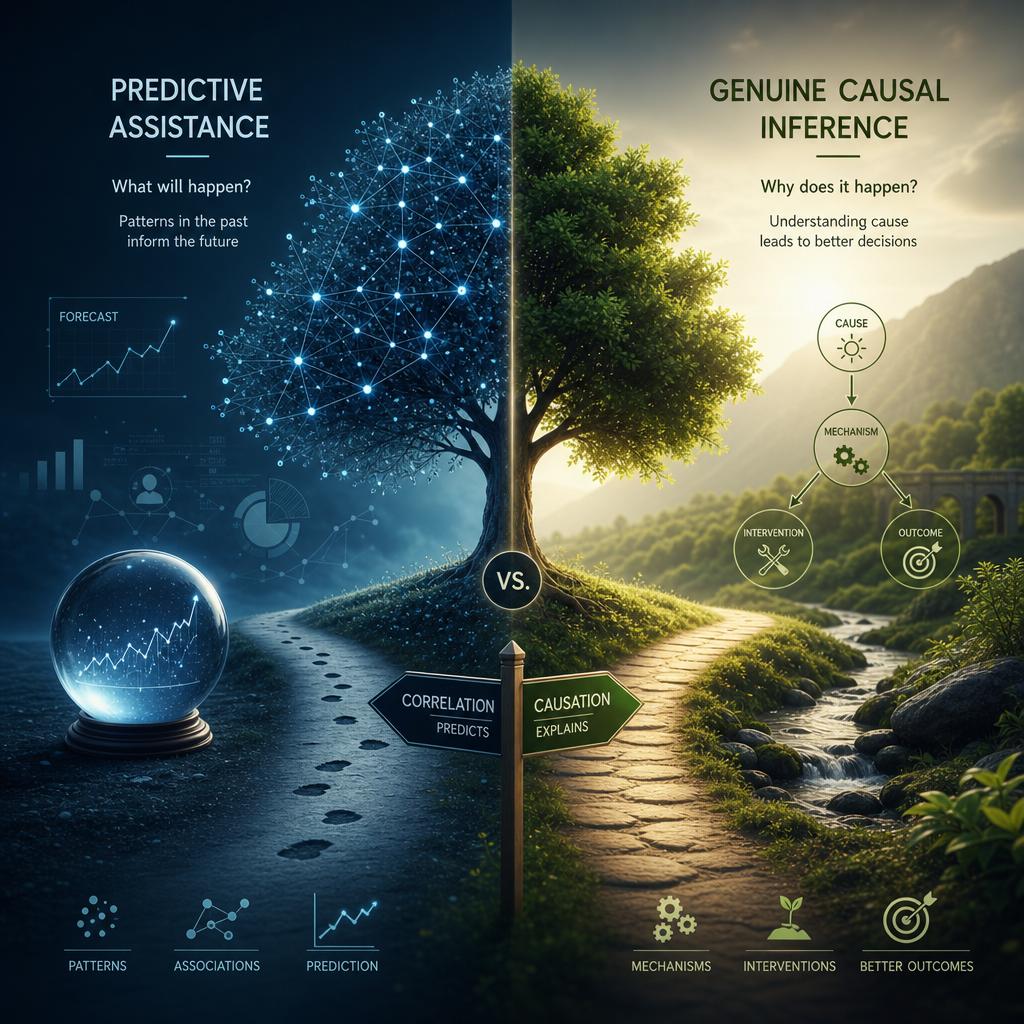
Distinguishing Between Predictive Assistance and Genuine Causal Inference in AI Models
Artificial Intelligence models have revolutionized data analysis by offering powerful predictive assistance that can identify patterns and forecast outcomes based on vast datasets. This capability, though, mainly focuses on correlations rather than cause-effect relationships. Predictive models excel in answering the “what might happen?” question but fall short when tasked with uncovering the underlying mechanisms driving those outcomes. The distinction is crucial: predictive tools often operate as sophisticated black boxes, delivering answers without explaining why an event occurs, which limits their use in scientific discovery and policy-making.
true causal inference, in contrast, demands not only correlation but also a rigorous framework to establish cause-and-effect links. This involves carefully designed experiments,counterfactual reasoning,and assumptions about the data-generating process. Techniques such as causal graphs and do-calculus aim to move beyond surface associations toward a deeper understanding of interventions and consequences. For clarity, consider this comparison:
| Aspect | Predictive assistance | Genuine causal Inference |
|---|---|---|
| Goal | Forecast outcomes based on data patterns | Identify cause-effect relationships |
| Methodology | Machine learning, statistical prediction | Counterfactuals, experimental design |
| Output | Probabilistic predictions | Actionable insights on causality |
| Scientific Impact | Useful for hypothesis generation | Enables intervention and policy decisions |
- Predictive models are indispensable for handling complex data but risk conflating correlation with causation.
- Causal inference methods require more stringent assumptions and data but lead to deeper scientific understanding.
- the integration of both approaches can empower AI systems to not only predict but also explain and prescribe.
Challenges and Limitations of AI in Establishing Scientific Causality
Despite AI’s notable ability to analyze vast datasets and identify correlations, it faces notable barriers when it comes to establishing true scientific causality. One major challenge is AI’s dependence on observational data, which frequently enough contains unmeasured confounding variables that can mislead causal inference. This limitation means that AI models might detect spurious relationships rather than genuine cause-effect links. Additionally, the ”black box” nature of many advanced AI algorithms obscures the reasoning behind their predictions, making it difficult for scientists to validate or interpret the causality purported by AI outputs. This opacity undermines trust and complicates efforts to mechanistically understand complex phenomena.
Key limitations include:
- Data Quality and Bias: AI’s effectiveness is tightly coupled to the quality and representativeness of the training data, with biased or incomplete datasets skewing causal conclusions.
- Contextual Understanding: Machines currently lack deep domain-specific knowledge and common-sense reasoning necessary for interpreting causal relationships beyond statistical associations.
- Intervention and Experimentation Deficits: AI typically cannot perform or simulate controlled interventions, which are foundational for establishing causality in scientific practice.
| Challenge | Impact on AI Causal Inference |
|---|---|
| unmeasured Confounders | Misleading associations, reduced causal validity |
| Algorithmic Opacity | Lack of interpretability and scientific trust |
| Insufficient Experimental Data | Limits definitive causal claims |
| Bias in Training Data | Distorts inference toward non-generalizable conclusions |
Strategic Recommendations for Integrating AI into Robust Causal Research Frameworks
Harnessing AI within causal research requires a deliberate balance between algorithmic power and rigorous theoretical grounding. It is indeed essential to implement obvious model specifications that allow researchers to trace causal pathways clearly rather than treating AI outputs as black boxes. Prioritizing interpretability can be achieved by integrating domain expertise into the training process, ensuring that AI assists in hypothesis generation and testing without overshadowing the foundational principles of causality. Additionally, the adoption of counterfactual frameworks combined with machine learning methods enhances the reliability of causal claims by framing AI-derived insights within well-established causal inference paradigms.
Furthermore, strategic incorporation of AI into causal research mandates institutional support for continuous validation and ethical oversight. Key recommendations include:
- Robust data curation: Ensuring datasets are representative and free from confounders mitigates bias in AI-assisted causal inference.
- Interdisciplinary collaboration: Combining statistics, computer science, and subject-matter expertise fosters thorough evaluation of causal models.
- Iterative refinement: Employing cycles of AI insight generation and domain-driven scrutiny strengthens the robustness of findings.
- Transparent reporting standards: Detailing methods and AI model parameters supports reproducibility and peer assessment.
| Aspect | Traditional Causal Research | AI-Enhanced Approach |
|---|---|---|
| Model Openness | High | Needs betterment |
| Data Scale | moderate | Large |
| Hypothesis Testing | Concept-driven | Hybrid (concept + data-driven) |
| Bias Control | Manual & theoretical | Automated + theoretical |