

AI Agents Coordination Fundamentals and Core Benefits
The orchestration of AI agents within a multi-agent system revolves around seamless coordination mechanisms that harmonize decision-making, communicationand task execution to achieve complex objectives. Central to this is the ability of agents to dynamically share facts, manage resource allocationand adapt their strategies in real time, thereby minimizing conflicts and maximizing collective efficiency. Such coordination allows for distributed problem-solving where the whole system can outperform individual agents, especially in environments characterized by uncertainty and rapidly changing conditions.
- Enhanced scalability through modular agent interactions
- Robustness achieved via redundancy and fault tolerance
- Improved adaptability when responding to unforeseen challenges
- Optimized resource usage driven by collaborative negotiation
| Coordination Aspect | Core benefit |
|---|---|
| Communication Protocols | Facilitates timely information exchange |
| Task Allocation | Distributes workloads to maximize throughput |
| Conflict Resolution | Minimizes inter-agent resource contention |
| collective Learning | Enables continuous optimization of group behavior |
Challenges in achieving Effective Multi-Agent Synchronization
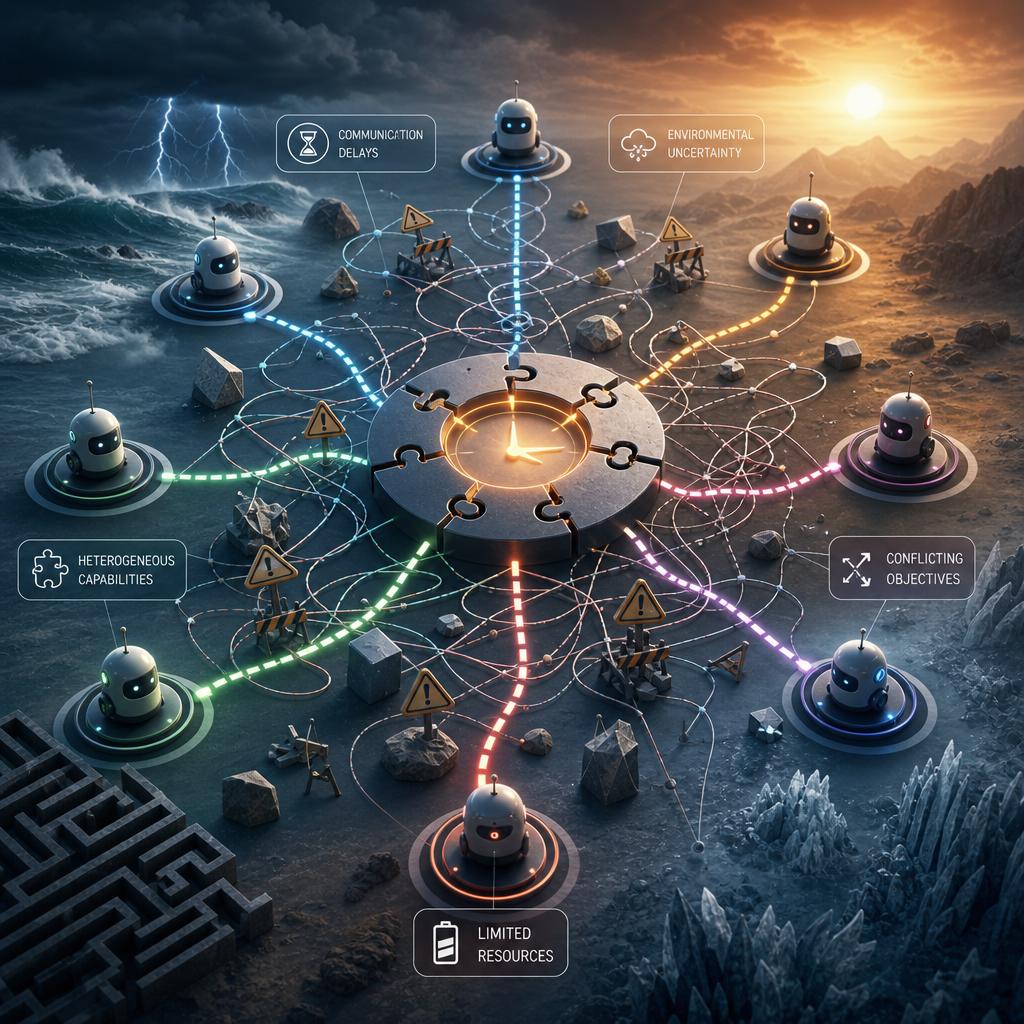
One of the foremost obstacles in synchronizing multiple AI agents lies in managing the dynamic and often unpredictable environments in which they operate. Each agent’s perception and decision-making processes can vary significantly, leading to potential conflicts or delays in task execution. This variability is compounded by communication latency and the risk of data inconsistencies across agents, which can disrupt seamless cooperation. Ensuring that all agents maintain a shared understanding of their state and environment requires robust consensus algorithms and adaptive communication protocols that can tolerate failures and unexpected changes without degrading overall system performance.
Moreover, achieving optimal coordination demands balancing computational resources against system responsiveness. High levels of synchronization frequently enough entail extensive information exchange and increased processing overhead, which can hinder scalability, notably in large-scale deployments. Consider the following challenges commonly encountered in multi-agent synchronization:
- Scalability Constraints: Maintaining synchronization as the number of agents grows exponentially increases complexity.
- Conflict Resolution: Agents frequently encounter competing objectives requiring rapid negotiation mechanisms.
- Fault Tolerance: Systems must handle agent failures gracefully without disrupting overall synchronization.
- Latency Sensitivity: Delays in message propagation can cause cascading synchronization errors.
| Challenge | Impact | Mitigation Strategy |
|---|---|---|
| Communication Delays | Desynchronization & Task Delays | Adaptive Buffer Management |
| Data Inconsistency | Conflicting Decisions | Consensus Protocols |
| Agent Failures | Reduced Robustness | Redundancy & Fault Detection |
Strategies for Enhancing Collaboration and Reducing Complexity
Effective collaboration among AI agents hinges on clear communication protocols and the establishment of well-defined roles within the system. By implementing hierarchical coordination structures, agents can delegate tasks and share information efficiently, thereby minimizing misunderstandings and redundant processes. Utilizing shared knowledge bases and standardized data formats further reduces friction, enabling agents to operate synergistically even in complex multi-agent environments. strategies such as consensus mechanisms and role adaptation dynamically align agent behaviors to evolving conditions,enhancing responsiveness and maintaining system coherence.
Reducing complexity in multi-agent systems also involves modular design principles and the selective simplification of interactions. by breaking down the system into manageable subunits, each governed by tailored coordination rules, developers can isolate and address conflicts before they escalate. Additionally, employing automated monitoring tools provides real-time feedback to detect emergent complexity. Below is a concise comparison of common approaches to structuring agent collaboration:
| Approach | Key Benefit | Typical Challenge |
|---|---|---|
| Centralized Coordination | Strong oversight and unified decision-making | Scalability bottlenecks |
| Decentralized Coordination | Robustness and flexibility | Complex conflict resolution |
| Hybrid Models | Balance of control and autonomy | Design complexity |
Best Practices and Recommendations for Scalable Multi-Agent Systems
Achieving scalability in multi-agent systems demands careful architectural planning and rigorous adherence to modular design principles. Decoupling agent functionalities allows systems to dynamically adjust to increasing workloads without performance degradation. Implementing robust communication protocols such as message queuing or event-driven architectures can minimize bottlenecks and facilitate seamless agent synchronization across diverse platforms. Moreover, leveraging hierarchical coordination frameworks enhances decision-making efficiency by delegating tasks through layered control mechanisms, which prevents overwhelming centralized controllers and reduces inter-agent communication overhead.
For optimal performance and maintainability, developers should incorporate the following best practices:
- Fault tolerance: Embed redundancy and recovery strategies to sustain agent operations despite failures.
- Scalable data management: Use distributed databases or decentralized ledgers to handle agent knowledge bases effectively.
- Continuous monitoring: Implement real-time analytics to track agent interactions and system health for proactive adjustments.
- Standardization: Adopt industry-standard protocols and ontologies to ensure interoperability and future-proof expansion.
| Practice | Benefit | Impact on Scalability |
|---|---|---|
| Decoupled Modules | Enhanced flexibility | Allows parallel growth and scaling |
| Hierarchical Control | Efficient task delegation | Reduces communication overhead |
| Fault Tolerance | Continuous operation | Improves system resilience |
| Standard Protocols | Interoperability | Facilitates integration and growth |