
Challenges in AI-Driven Complex Software Architecture
As AI systems increasingly take on the coding of complex software, they frequently enough confront inherent limitations when addressing multi-layered architecture design. These challenges arise primarily from AI’s dependence on existing data and predefined patterns, which constrains its ability to innovate novel solutions. Unlike human architects, AI lacks the intuitive grasp of domain-specific contexts and the foresight to anticipate evolving requirements. This results in struggles with integrating diverse modules, ensuring robust scalability, and maintaining seamless interoperability across components. Additionally,the nuance required for balancing trade-offs in performance,security,and maintainability frequently enough eludes automated systems designed to optimize primarily for immediate efficiency metrics.
Key difficulties faced by AI in complex software design include:
- Contextual Adaptation: AI algorithms cannot fully internalize real-world domain complexities or unexpected edge cases.
- creative Problem-Solving: Novel architectural approaches that break from past patterns are rarely generated autonomously.
- Interpretability Issues: Generated designs may lack clarity, complicating maintenance and iterative improvements.
| Aspect | AI Limitation | Human Advantage |
|---|---|---|
| Design Innovation | Predictive but bounded by training data | Intuition-driven creative leaps |
| Complex Integration | Difficulty managing heterogeneous components | Holistic understanding of systems |
| Requirement Evolution | Static adaptation to novel demands | Flexible anticipation and iteration |
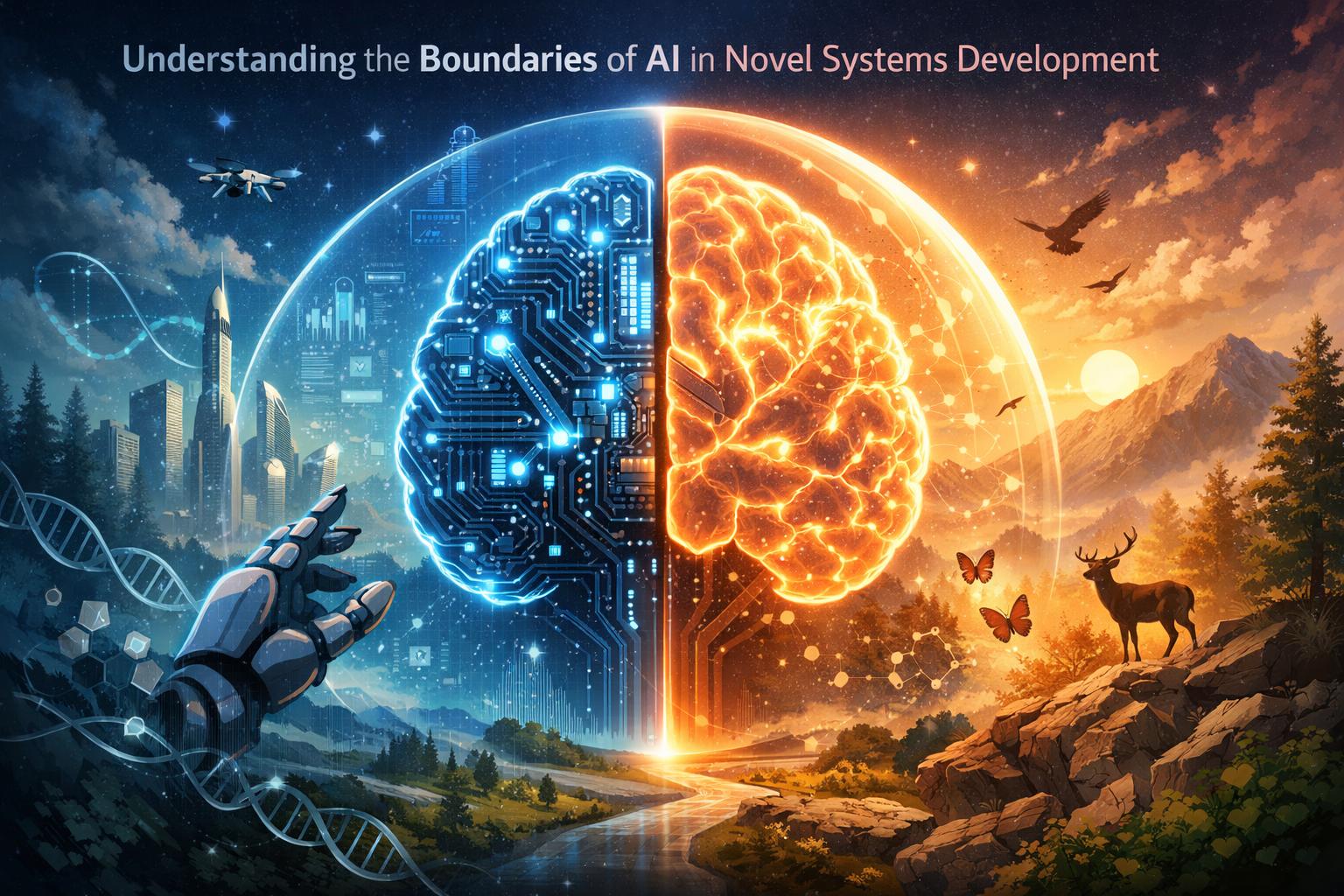
Understanding the Boundaries of AI in Novel Systems Development
Artificial intelligence has undeniably transformed many facets of coding by automating routine tasks and optimizing existing frameworks. However, when it comes to pioneering complex architectures and novel systems, AI encounters significant limitations. Unlike human creativity and intuition, much of AI’s functioning depends on processing patterns from historical data and predefined rules. This intrinsic reliance often restricts AI from breaking into entirely uncharted territories where innovative problem-solving demands abstract thinking and contextual awareness beyond algorithmic prediction.
Key challenges in deploying AI for advanced system design include:
- Ambiguity in requirements: New systems often arise from vague or evolving requirements, which AI struggles to interpret without clear datasets.
- High-level integration: Combining diverse technologies and paradigms requires nuanced judgment and foresight that are still primarily human traits.
- Unpredictable outcomes: Novel solutions can generate unforeseen behaviors, requiring flexibility and adaptability beyond current AI capabilities.
| Aspect | Human Strength | AI Limitation |
|---|---|---|
| Creativity | Invents new concepts and abstractions | Relies on existing patterns and data |
| Contextual Understanding | Interprets nuanced situational factors | Struggles with ambiguous or incomplete info |
| Risk Management | Anticipates and mitigates potential failures | Limited foresight in novel scenarios |
Strategies for Integrating Human Expertise with AI in Advanced Coding
To maximize the potential of AI in coding while addressing its inherent limitations in complex design and novel systems, a collaborative model should be adopted where human expertise guides and complements the AI. Developers bring critical thinking, intuition, and deep contextual understanding that AI currently lacks. For instance,seasoned engineers can set precise problem boundaries,interpret ambiguous requirements,and anticipate edge cases,ensuring that AI-generated code aligns with broader architectural goals. This partnership fosters a feedback loop where humans validate and refine AI outputs, driving incremental improvements in both code quality and system robustness.
Effective integration entails implementing systematic workflows that leverage both strengths through:
- Iterative code review cycles: Human experts scrutinize AI-generated code to catch subtle design flaws and optimize performance.
- Hybrid debugging processes: Combining AI-powered anomaly detection with human judgment to diagnose complex issues faster.
- Context-aware training datasets: Curating data that reflects real-world scenarios guided by expert insights to enhance AI model relevance.
- Continuous knowledge transfer: Extracting learnings from human corrections to inform AI learning algorithms, reducing repetitive errors.
| Role | Key Contribution | Outcome |
|---|---|---|
| Human Expert | Domain insight, contextual judgment | Ensures system innovation adheres to strategic goals |
| AI System | Rapid code generation, pattern recognition | Accelerates prototyping and error detection |
| Collaborative Workflow | Iterative validation and optimization | Boosts code reliability and design coherence |
Best Practices for Leveraging AI While Mitigating Design Limitations
When integrating AI into complex design systems, developers must prioritize a balanced approach that leverages strengths without overlooking inherent constraints. Thorough human oversight remains essential to catch subtle nuances and edge cases that AI models might miss. Employing iterative review cycles, combining AI-generated outputs with expert validation, ensures that innovation is not compromised by overlooked design intricacies. additionally,maintaining transparent documentation of AI-driven decisions aids in recognizing potential limitations early,allowing teams to adapt their strategies proactively.
- Establish feedback loops: Continuous input from domain experts to refine AI suggestions.
- Modular design approach: Break systems into smaller components to isolate AI-driven elements for easier troubleshooting.
- Set clear boundaries: define areas where AI assistance is appropriate versus those requiring exclusive human control.
- Leverage hybrid models: Combine rule-based logic with AI to navigate novel challenges more reliably.
| Best Practice | Benefit | example |
|---|---|---|
| Human-in-the-loop Validation | Reduces critical design errors | Senior engineer reviews AI code proposals |
| Iterative Feedback | Improves adaptation over time | Weekly sprint meetings to refine AI outputs |
| Modular Architecture | Enhances fault isolation | Microservices handling AI-generated features |