
The Capabilities and Boundaries of Artificial Intelligence in Creative Writing
Artificial intelligence has made impressive strides in generating text that mimics human creativity, yet its capacity to craft compelling books remains bounded by several core limitations. While AI can efficiently produce coherent prose, generate plot outlines, and even mimic writing styles, it largely operates by analyzing vast datasets rather than imagining original concepts. This reliance on existing materials means AI typically excels in reproduction and variation rather than true innovation. Moreover, AI-generated narratives frequently enough lack the nuanced emotional depth and thematic consistency found in human-authored works, which stem from lived experience and introspective insight.
Understanding these boundaries is essential for appreciating the complementary relationship between AI tools and human creativity.Some key facets that delineate AI’s role in creative writing include:
- Predictive Text vs. Visionary Creation: AI predicts plausible word sequences based on training data but does not originate transformative ideas.
- Pattern Recognition vs. Emotional Intuition: Machines identify linguistic patterns without truly grasping subtle emotional subtext.
- Speed and volume vs.Artistic Refinement: AI can generate large volumes of text rapidly but usually struggles with crafting multi-layered narratives that resonate deeply.
- Rule-Based Generation vs. Ethical Judgment: AI lacks moral reasoning, which is critical when addressing controversial or culturally sensitive themes.
| Capability | AI Strength | Human Strength |
|---|---|---|
| Generating Plot Ideas | Quick synthesis of existing tropes | Inventive, contextually rich concepts |
| Writing Style | Imitates specific authors accurately | Original and evolving voice |
| Emotional Depth | Limited to surface-level cues | Profound, layered emotional experience |
| Ethical Reflection | Absent | Integral to storytelling choices |
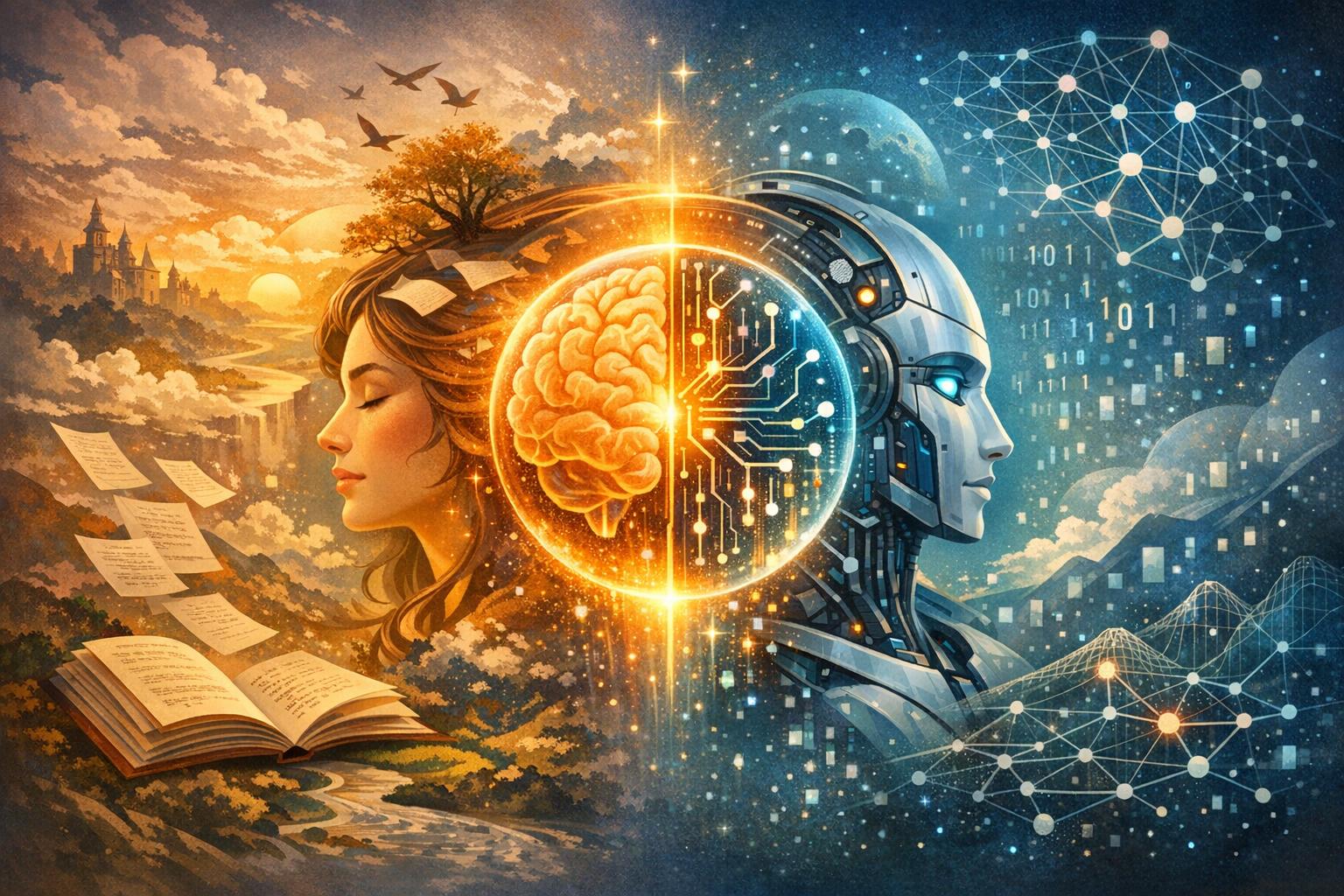
Comparing Human Intuition and Machine Learning in Narrative Construction
Human intuition in crafting narratives is rooted in deep emotional understanding, cultural context, and an innate sense of storytelling that has evolved over millennia. It enables writers to weave nuanced subtexts and complex characters that resonate uniquely with diverse audiences. This intuitive process is fluid, often non-linear, and driven by a subconscious synthesis of life experiences, making stories feel authentic and emotionally compelling. In contrast, machine learning models rely on patterns learned from vast datasets.While these AI systems can generate coherent text and mimic styles, they lack the genuine emotional depth and existential insight that human authors bring to the creative process.
AI excels at processing and recombining existing narrative elements quickly, yet it struggles with originality beyond learned data and understanding the tacit emotional cues that humans instinctively grasp. Consider the table below illustrating key differences:
| Aspect | Human Intuition | Machine Learning |
|---|---|---|
| Emotional depth | Innate and experiential | Simulated through pattern recognition |
| Creativity | Conceptual leaps and abstract thinking | Recombination of existing data |
| Contextual Awareness | Dynamic cultural and social context | Limited to data scope |
| Imperfect, Subjective Insight | Frequently enough essential for meaningful storytelling | Generally absent or inconsistent |
- Human skill breathes life into narrative through empathy and moral questioning.
- Machine learning enhances efficiency and scale but lacks true understanding.
- Optimal storytelling might arise from a collaborative synergy of both.
Ethical Considerations and Quality Control in AI-Generated literature
As artificial intelligence encroaches further into the realm of creative writing, it brings with it pressing ethical questions. AI-generated literature raises concerns about originality, authorial transparency, and intellectual property rights.Authors, publishers, and readers alike must navigate the blurred boundaries between machine output and human creativity, ensuring that AI serves as a tool rather than a deceptive replacement. Accountability becomes paramount, especially when content produced could inadvertently propagate biases or misinformation embedded in training data. Publishing platforms and literary institutions are called upon to establish clear guidelines and standards to maintain trust and integrity in the literary ecosystem.
Maintaining high standards of quality control in AI-generated texts requires a strategic approach incorporating both human judgment and automated evaluation. Editors and literary critics play an essential role in refining AI drafts, guiding narrative coherence, and preserving stylistic nuance that machines may overlook. Incorporating rigorous quality checks, consider the following focal points:
- Factual Accuracy: Verifying data AI introduces to avoid errors or fabrications.
- Stylistic Consistency: Ensuring the tone and voice align with intended audience expectations.
- Ethical Sensitivity: Reviewing content for cultural, social, and moral implications.
| Quality Aspect | AI Challenge | Human Intervention |
|---|---|---|
| Originality | Risk of plagiarism from training data | Creative rewriting and idea validation |
| Context Awareness | Limited understanding of nuance | Contextual editing and thematic adjustments |
| Emotional Depth | Mechanical emotions, lack of empathy | Infusing human experience and tone |
Best Practices for Integrating AI Tools with Human Authorship in Book Production
Maximizing the synergy between AI tools and human creativity requires a strategic approach that values the unique strengths of both. AI excels at processing vast amounts of data, generating initial drafts, and offering fresh perspectives on plotlines or factual accuracy. Though, the essence of compelling storytelling-emotional depth, nuanced character development, and cultural context-remains squarely in the human domain. To harness AI effectively, authors should use these tools as collaborative assistants rather than replacements, iteratively refining AI-generated content through their editorial vision and personal voice.
- Define clear roles: Assign AI to tasks like research aggregation, language variation, or generating plot ideas, while reserving narrative cohesion and thematic decisions for humans.
- Implement quality checkpoints: Rigorous human review is vital to catch errors, biases, and irrelevant content that AI might introduce.
- maintain ethical transparency: clearly disclose AI involvement to uphold readers’ trust and literary authenticity.
| Aspect | Human Strength | AI Strength |
|---|---|---|
| Creativity | Original ideas, emotional resonance | Idea generation, pattern recognition |
| Consistency | Maintaining voice and style | repetitive tasks, fact-checking |
| Editing | Contextual nuance, tone adjustment | Grammar and syntax correction |
Adopting this balanced framework not only enhances efficiency in book production but also preserves the irreplaceable qualities of human craftsmanship. When AI serves as an augmentation rather than an author, the final work benefits from both the precision of technology and the artistry of human insight, creating books that resonate deeply while meeting modern demands for speed and scalability.