
The Evolution of Generative Models in Artistic Creation
From the early experiments wiht rule-based algorithms to today’s refined neural networks, the journey of generative models in artistic creation has been nothing short of revolutionary. Initial models relied heavily on fixed patterns and predefined templates, limiting the scope of creativity to mechanical replication. However, the advent of deep learning and generative adversarial networks (GANs) introduced a paradigm shift, enabling machines to not only learn intricate artistic styles but also to innovate beyond human-imposed constraints. This evolution has empowered artists and technologists alike to push boundaries, creating artworks that challenge conventional notions of creativity and authorship.
Key milestones in this evolution can be framed through the capabilities that each generation of models brought forward:
- Rule-based Systems: Simple, deterministic outputs limited to predefined patterns.
- statistical Models: Basic probabilistic variations introducing some unpredictability.
- Neural Networks: Ability to decipher complex artistic features from vast data.
- Generative Adversarial Networks: co-evolution of generator and discriminator, fostering creativity through competition.
- Transformers and Diffusion Models: Generating highly detailed, nuanced, and context-aware artworks.
| Era | Technological Breakthrough | Artistic Impact |
|---|---|---|
| 1980s-1990s | rule-Based Algorithms | Structured,repetitive patterns |
| 2000s | Statistical Approaches | Variation with limited innovation |
| 2010s | gans & Deep Learning | Authentic style synthesis |
| 2020s | Transformers & Diffusion | complex,context-rich creations |
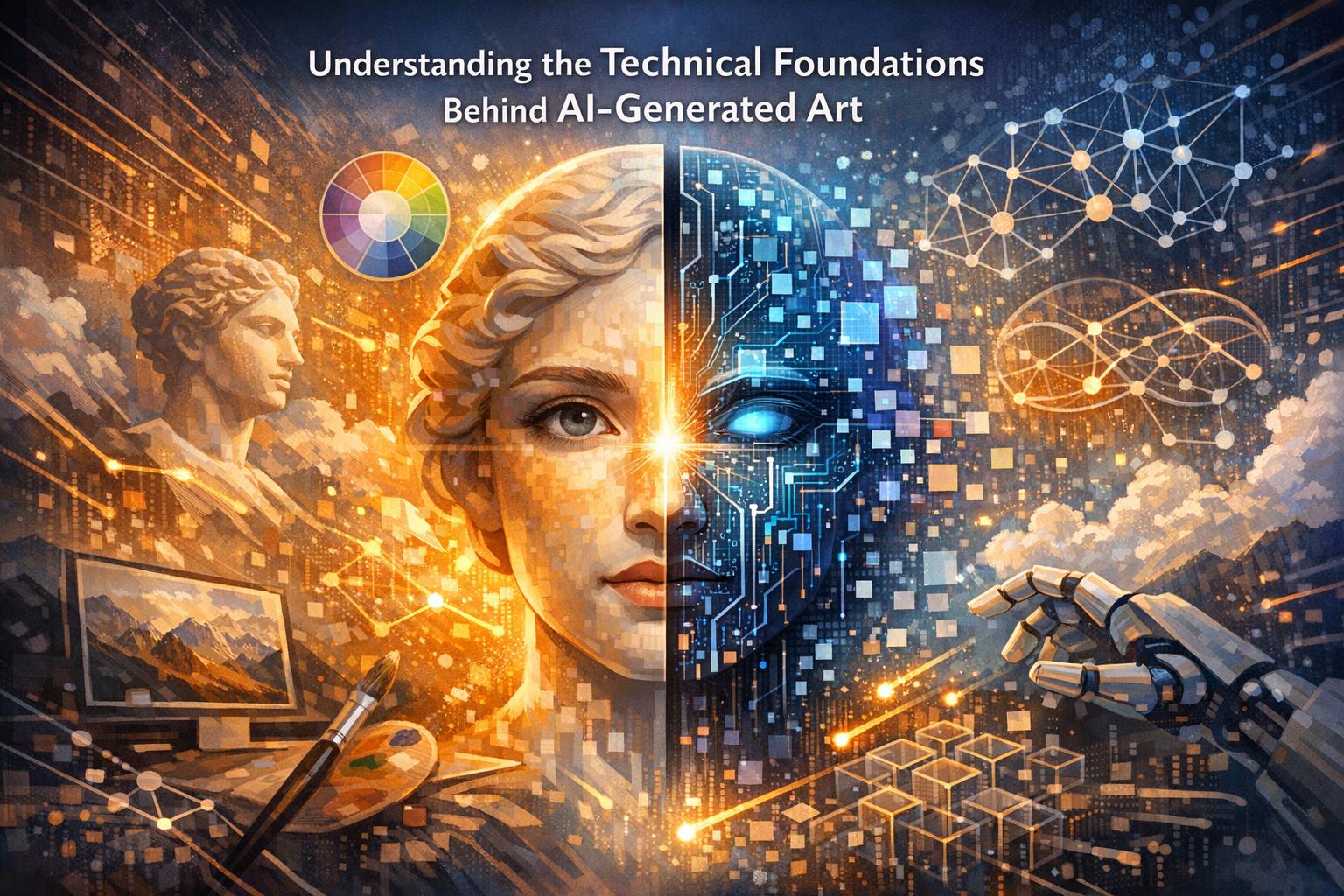
Understanding the Technical Foundations Behind AI-Generated Art
At the core of AI-generated art lies an intricate web of generative models, which leverage deep learning algorithms to produce novel images, patterns, and styles.These models are predominantly based on neural networks, with Generative Adversarial Networks (GANs) and Variational Autoencoders (VAEs) being the most prominent architectures. GANs work through a dynamic interplay between two components: a generator crafting images and a discriminator evaluating their authenticity. This game-theoretic approach pushes the generator to produce outputs that increasingly mimic real art, enabling AI to generate visuals that are often indistinguishable from human-created masterpieces.
Key technical concepts driving this revolution include:
- Latent Spaces: High-dimensional zones where abstract representations of art are encoded and decoded.
- Training Data: Vast datasets of images that teach the AI stylistic nuances, color schemes, and compositional rules.
- Backpropagation: An optimization technique allowing networks to minimize errors and enhance output quality over iterations.
| Model Type | Primary Function | Example Output |
|---|---|---|
| GAN | Generate realistic images via adversarial training | Photorealistic portraits |
| VAE | Encode images to latent space and generate variations | Abstract artistic styles |
| Transformer-based Models | generate images from textual prompts | Concept art from descriptions |
Evaluating the Authenticity and Originality of AI-Created Works
Determining the authenticity of AI-generated artworks challenges traditional definitions of creativity and originality. Unlike human creators, AI systems generate pieces based on patterns extracted from massive datasets of existing art, raising questions about the genuine novelty of their output. When we consider originality in art, it is often tied to the artist’s intent, emotional expression, and unique perspective-qualities difficult to attribute to algorithms.However, AI’s contribution lies in the synthesis of diverse influences and novel combinations, which can sometimes surpass human imagination in complexity and scale. This coexistence of borrowed elements and innovation calls for new frameworks to assess an AI artwork’s legitimacy.
- Source Clarity: Understanding the datasets and training processes behind the model.
- Creative Intent: Identifying human involvement in directing or curating AI outputs.
- Contextual Impact: Evaluating the cultural and emotional resonance with audiences.
| Aspect | Human Art | AI Art |
|---|---|---|
| Creativity Source | Innate human experience | Pattern synthesis from data |
| Originality | unique expression and intention | Generated novelty through algorithmic iteration |
| Emotional Depth | Personal and cultural contexts | Indirect, emergent from user interaction |
Best Practices for integrating AI Tools into Contemporary Art Practices
Harnessing AI tools for art creation demands a intentional approach centered on both ethical considerations and technical fluency. Artists should prioritize clear experimentation with generative models, embracing the fluidity these systems offer while maintaining an informed perspective on the provenance of their outputs. An effective strategy involves integrating AI not as a replacement for creativity but as an extension, where artists retain curatorial control-selecting, refining, and contextualizing AI-generated pieces to complement their unique vision.
- understand AI capabilities and limitations: Gain hands-on experience with various generative models, from GANs to diffusion techniques.
- Maintain ethical use: avoid plagiarism by acknowledging datasets and respecting original creators.
- Iterative collaboration: Use AI outputs as raw materials for continuous refinement rather than final products.
- Document the creative process: Share insights and methodologies to contribute to the evolving discourse on AI art.
| aspect | Recommended Practice | Outcome |
|---|---|---|
| Model Selection | Choose models aligned with artistic goals | Coherent, relevant outputs |
| Data Ethics | Use publicly licensed or self-curated datasets | Respect for intellectual property |
| Human Input | Guide and edit AI-generated content | Personalized and meaningful art |